
Campylobacter jejuni DNA PCR Quantitative Positive Control – High-Quality Reference Material for Molecular Detection
Meta Description: Learn about Campylobacter jejuni DNA PCR Quantitative Positive Controls, their structure, preparation, qPCR calibration role, and biosafety use in molecular research. Includes 20+ references to authoritative .edu and .gov sources.
Introduction: Why Campylobacter jejuni Controls Are Essential in Molecular Research
Campylobacter jejuni is a microaerophilic, spiral-shaped bacterium widely used in academic research for studying bacterial motility, genome plasticity, and environmental resilience.
In quantitative PCR (qPCR) or real-time PCR workflows, the Campylobacter jejuni DNA PCR Quantitative Positive Control serves as a standardized template for verifying assay sensitivity, reproducibility, and cross-run comparability.
Using a certified DNA control avoids variability between runs and helps laboratories confirm the linear dynamic range, amplification efficiency, and threshold cycle (Ct) reliability of their molecular assays.
Authoritative references such as the CDC Laboratory Guidance, NIH Genomic Research Portal, and USDA NAL Microbiology Guides describe how DNA reference materials stabilize assay validation frameworks across molecular platforms.
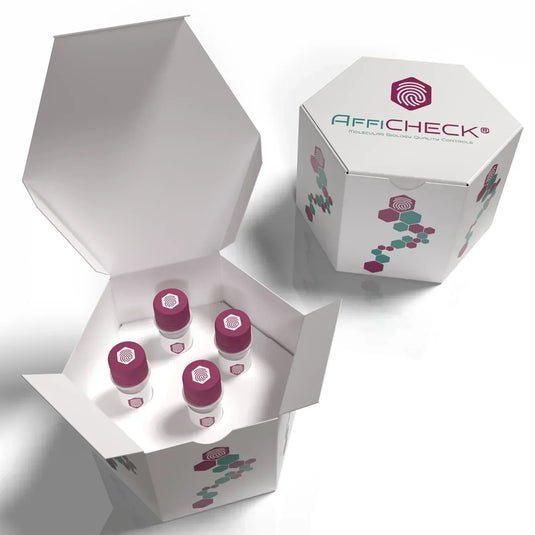
Overview of Campylobacter jejuni DNA and Genome Structure
The Campylobacter jejuni genome is approximately 1.6–1.7 Mb with a G+C content near 30%. It encodes genes involved in:
-
Flagellar motility (critical for colonization and chemotaxis)
-
Iron acquisition and oxidative stress response
-
DNA methyltransferase systems contributing to phase variation
-
Metabolic adaptability for survival in microaerophilic environments
These genomic traits make C. jejuni an ideal control model in qPCR and RT-PCR for DNA integrity verification and amplification curve calibration.
For full genome references, consult the NCBI Genome Database, GenBank, and NCBI Bookshelf Microbiology Collection.
Role of Quantitative Positive Controls in PCR and qPCR Systems
A Quantitative Positive Control (QPC) is a DNA standard containing a known number of target copies per microliter.
When included in a PCR or qPCR assay, it allows researchers to:
-
Validate the analytical sensitivity of the amplification reagents
-
Monitor instrument calibration (e.g., light source intensity, detection thresholds)
-
Create standard curves for absolute quantification
-
Detect pipetting or reagent drift across runs
Typical concentrations range from 10³ to 10⁸ copies/µL, depending on the assay design.
These standards can be plasmid-based, linearized fragments, or synthetic gBlocks carrying a species-specific sequence, such as the mapA or hipO gene in C. jejuni.
For detailed principles of qPCR calibration and standards, see:
Campylobacter jejuni DNA Control Preparation and Composition
The Campylobacter jejuni DNA Quantitative Positive Control is produced by isolating high-purity genomic or plasmid DNA carrying a target-specific region.
Each batch typically undergoes:
-
Spectrophotometric analysis (A260/A280 ≥ 1.8)
-
Integrity testing by agarose gel electrophoresis
-
Concentration quantification by fluorometric assay (e.g., Qubit or PicoGreen)
-
Stability evaluation under long-term storage (−20 °C or below)
The DNA fragment corresponds to a unique region conserved within C. jejuni species, ensuring no cross-reactivity with C. coli, C. lari, or other Campylobacter spp.
For molecular biology standards, refer to NIST DNA Quantitation Standards and NIH Genetic Material Handling Guidelines.

Quantitative Curve Generation Using the Positive Control
Step-by-Step Standard Curve Setup:
-
Prepare serial tenfold dilutions (e.g., 10⁸ → 10² copies/µL).
-
Run each dilution in triplicate in the same plate.
-
Plot Ct values vs. log10(copy number) to determine slope and R².
-
Calculate PCR efficiency (E) using the formula:
E=10(−1/slope)−1E = 10^{(-1/slope)} – 1
Acceptable range: 90–110%.
A well-calibrated standard curve ensures that unknown samples yield accurate quantification within the validated dynamic range.
More about amplification efficiency and standard curves can be found on:
Applications in Academic and Industrial Research
The Campylobacter jejuni DNA Positive Control supports various experimental goals:
-
Environmental microbiology: detecting Campylobacter persistence in water or food matrices.
-
Comparative genomics: calibrating inter-laboratory qPCR data.
-
Microbial ecology: tracking population abundance in mixed cultures.
-
Educational use: standard for teaching PCR technique reproducibility.
It is a non-hazardous reference standard that does not contain viable bacteria.
For biosafety, consult CDC BMBL and institutional biosafety guidelines such as Stanford Biosafety Manual or UC Berkeley Biosafety Manual.
Quality Control and Verification
To ensure precision, each batch is validated for:
-
Reproducibility: consistent Ct values across multiple runs.
-
Specificity: absence of amplification in non-target DNA.
-
Stability: minimal degradation after repeated freeze–thaw cycles.
-
Quantitative consistency: less than 5% variation across dilutions.
Data and reference certificates should accompany each lot, aligning with ISO 20395:2019 guidelines for quantitative molecular assays.
For reference material traceability, academic users often refer to NIST SRM Libraries and EPA Genomic Quality Control Resources.
Example Workflow Integration
A typical workflow for using this control includes:
-
Reconstitute the DNA in nuclease-free water.
-
Store aliquots at −20 °C to prevent degradation.
-
Include 2–3 control concentrations in each qPCR run.
-
Validate the limit of detection (LOD) using ≥20 replicates of low-concentration controls.
-
Document and compare results between instruments or reagent lots.
This practice aligns with recommendations from NIH Reproducibility Initiatives and NIAID Standardization Guidelines.
Advantages of Using Certified Quantitative DNA Controls
-
Lot-to-lot consistency for longitudinal projects
-
Reduced variability across reagents and thermocyclers
-
Reliable amplification efficiency benchmarking
-
Improved publication reproducibility through standardized calibration
-
Safer handling—non-viable and ready-to-use DNA templates
Comprehensive laboratory practice is further supported by resources like the Harvard Recombinant DNA Policy and UCSF Biosafety Program.
Data Analysis and Interpretation Guidelines
During amplification:
-
The Ct value should decrease linearly with increasing copy number.
-
R² ≥ 0.99 indicates high precision.
-
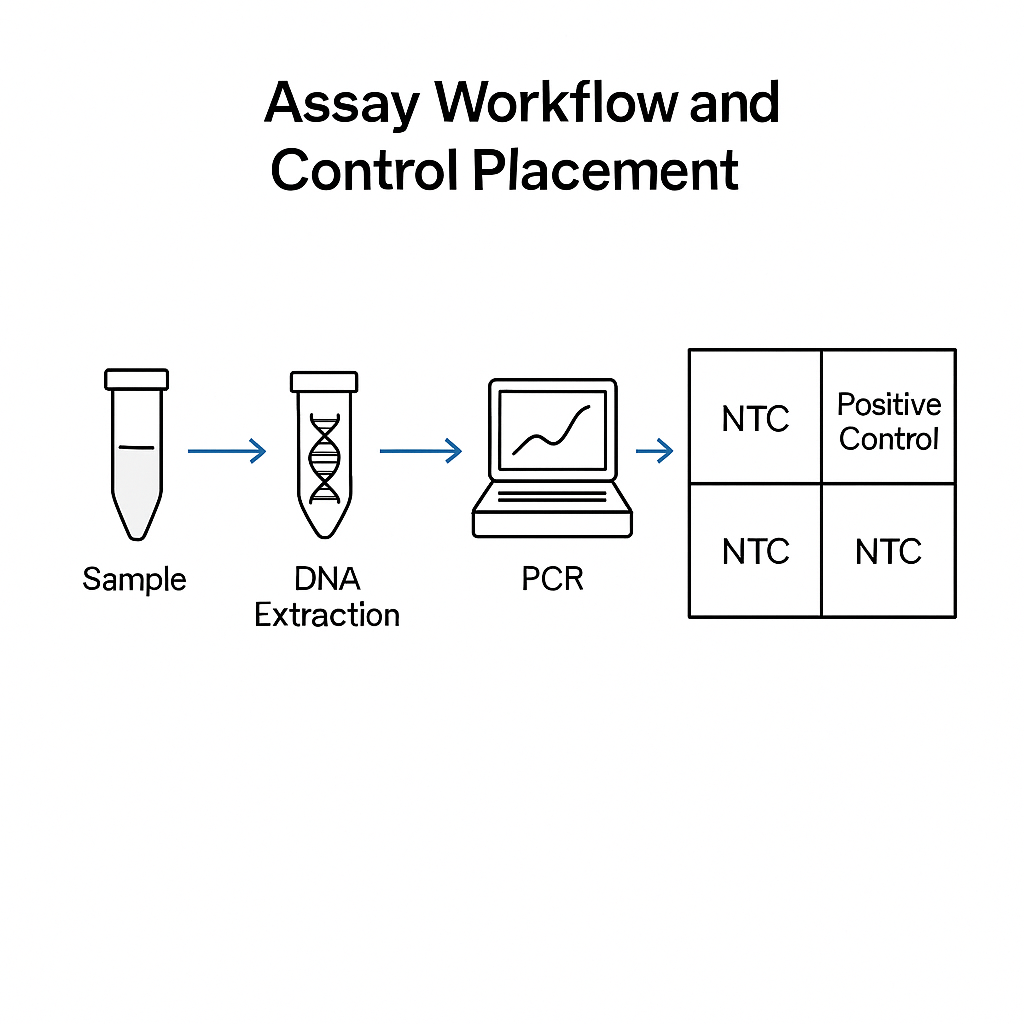
No-template controls (NTC) must show no amplification signal.
-
Efficiency deviations indicate pipetting or reagent inconsistencies.
For curve fitting and linear regression, NCBI Tools and NIH PMC Biostatistics Resources provide computational examples.
Storage and Stability Recommendations
The Campylobacter jejuni DNA Positive Control is stable for up to 24 months under proper storage.
Avoid multiple freeze–thaw cycles; divide the master stock into single-use aliquots.
Freeze at −20 °C or below and protect from repeated temperature fluctuations.
Stability testing follows standard molecular reagent handling practices per NIH Laboratory Best Practices and EPA DNA Integrity Guidelines.
Troubleshooting Tips
| Observation | Possible Cause | Corrective Action |
|---|---|---|
| High Ct values | DNA degradation or low template input | Check concentration; use fresh aliquot |
| Non-linear curve | Pipetting error or contamination | Repeat dilutions under sterile conditions |
| No amplification | Thermocycler calibration issue | Verify annealing temperature and reagent quality |
| Variable triplicates | Poor mixing | Vortex thoroughly and briefly centrifuge before use |
See related qPCR troubleshooting tutorials from NIH PMC and USDA Laboratory Guidebook.
Authoritative .edu / .gov References
The Campylobacter jejuni DNA PCR Quantitative Positive Control provides a reliable DNA standard for qPCR and PCR assay validation. It ensures consistent amplification performance, precise quantification, and reproducible calibration. Certified for purity and stability, it’s ideal for genomic research, molecular teaching labs, and environmental DNA applications.