
The 10X Universal Primer Mix (UPM) is a specialized reagent formulation used in molecular biology for reverse transcription and cDNA amplification. It ensures efficient and uniform priming during the synthesis of complementary DNA (cDNA) from diverse RNA templates. UPMs are central to techniques like SMARTer™ (Switching Mechanism At the 5′ End of RNA Template) cDNA synthesis and other template-switching PCR systems.
Originally developed to enhance full-length cDNA coverage, the 10X UPM enables high sensitivity, broad template compatibility, and reduced amplification bias, as described in early research from the National Center for Biotechnology Information (NCBI).
Overview and Composition of Universal Primer Mix
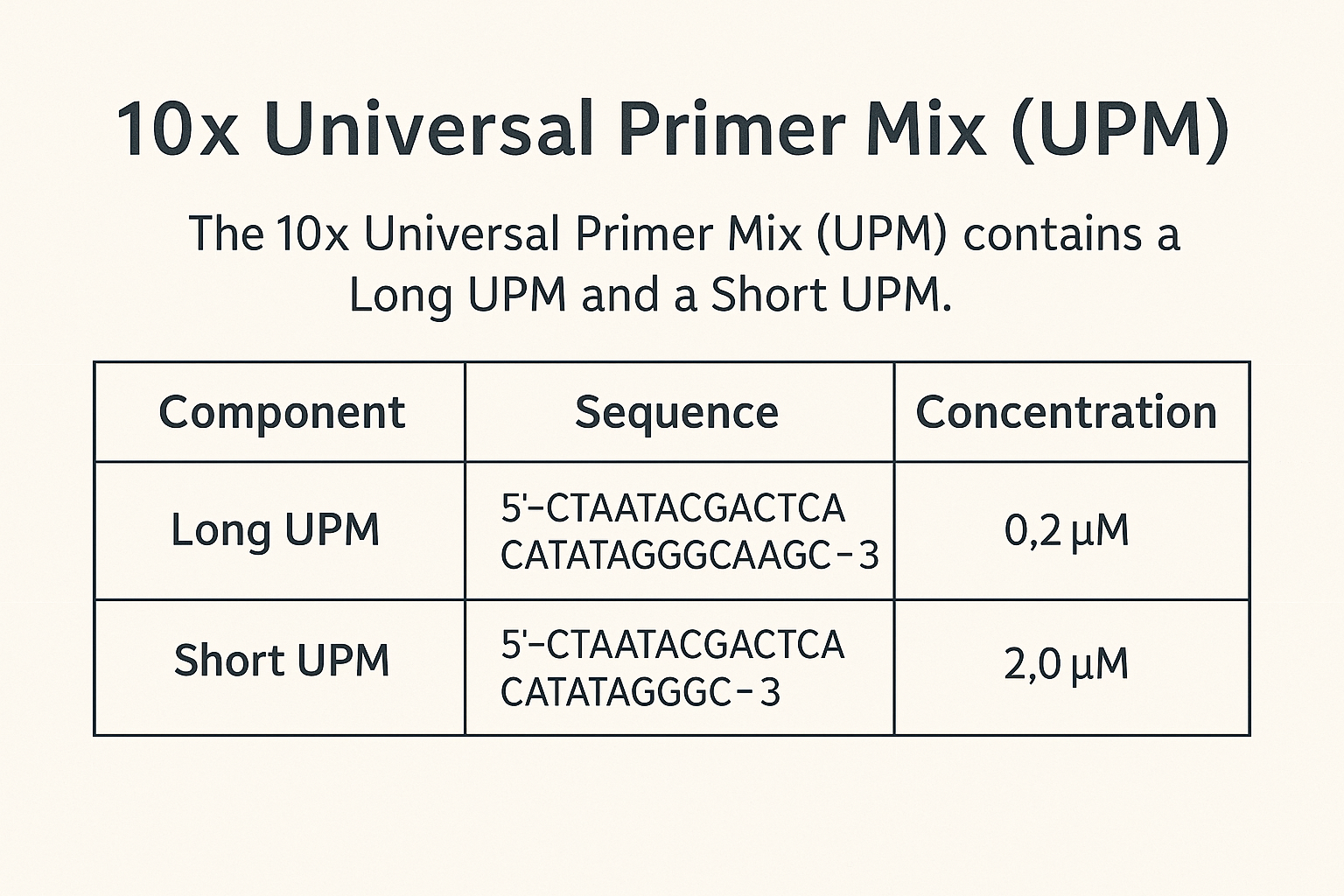
The 10X Universal Primer Mix typically contains a combination of:
-
Long Universal Primer (UPM-L): 5′-CTAATACGACTCACTATAGGGCAAGCAGTGGTATCAACGCAGAGT-3′
-
Short Universal Primer (UPM-S): 5′-CTAATACGACTCACTATAGGGC-3′
These primers function together to ensure balanced amplification efficiency for both short and long cDNA fragments. According to studies from the National Institutes of Health (NIH), such dual-primer systems prevent amplification failure due to incomplete template extension or secondary structures.
For sequence details and experimental data, visit the NCBI Oligonucleotide Database.

Principle of Function: Template Switching and SMART Mechanism
In SMART (Switching Mechanism at the 5′ End of RNA Template)-based systems, reverse transcriptase adds non-templated cytosine residues to the 3′ end of newly synthesized cDNA. The SMART oligo, containing a complementary guanine stretch, hybridizes to this region and introduces a universal priming site at the 5′ end of the cDNA.
During subsequent PCR, the 10X Universal Primer Mix binds to this newly added sequence, enabling full-length amplification of cDNA molecules.
Mechanistic explanations can be found in protocols from the University of California, San Diego Molecular Biology Department and the U.S. Department of Energy Joint Genome Institute.
Advantages of Using 10X UPM in cDNA Synthesis
Researchers at Harvard University and Stanford Medicine have demonstrated several benefits of 10X UPM in transcriptional studies:
-
Universal compatibility across RNA templates
-
Reduced primer-dimer formation
-
High-fidelity amplification using SMARTScribe™ or MMLV reverse transcriptases
-
Accurate representation of low-abundance transcripts
-
Simplified library preparation for cloning or sequencing
Its optimized primer balance promotes even amplification, especially important in RNA-Seq, RACE-PCR, and full-length cDNA library construction, as referenced by the NIH Gene Expression Omnibus (GEO).
Application Areas
The 10X Universal Primer Mix is widely used in:
-
Reverse transcription-PCR (RT-PCR)
-
Rapid Amplification of cDNA Ends (RACE)
-
SMARTer cDNA synthesis protocols
-
Single-cell transcriptomics
-
Gene expression profiling
-
Molecular cloning and library normalization
In multi-step workflows, UPM serves as a bridge between reverse transcription and PCR, providing both universal priming and amplification reliability. Examples can be found in training materials from the University of Michigan Department of Molecular, Cellular, and Developmental Biology.
Mechanistic Insights: Why Use Two Primers?
The combination of long and short universal primers ensures robustness.
-
The long UPM enhances priming specificity and yields longer cDNA amplicons.
-
The short UPM maintains amplification efficiency for shorter fragments or templates with strong secondary structures.
This duality is particularly valuable when working with heterogeneous RNA populations, such as total RNA from tissue extracts or viral RNA.
For theoretical background, refer to studies archived in the Journal of Molecular Biology and NIH PubMed Central.
Optimization Parameters for PCR
Using 10X UPM requires careful optimization of:
-
Annealing temperature: typically 65 °C for SMARTer systems
-
Cycle number: 20–25 for analytical PCR; 35 for low-copy templates
-
Mg²⁺ concentration: 1.5–2.5 mM for enzyme cofactor stability
-
Template quantity: 1–10 ng cDNA
Reference protocols for these conditions are provided in FDA Laboratory Method Development Guides and NIST PCR Measurement Standards.
Comparison with Conventional Priming Systems
Unlike random hexamers or oligo(dT) primers, the 10X UPM:
-
Provides a defined universal priming site
-
Allows consistent amplification across samples
-
Facilitates seamless cloning into vectors for sequencing or expression
-
Works efficiently with low-input RNA (as low as 1 pg)
Researchers from the University of Wisconsin Biotechnology Center have shown that UPM outperforms generic primers in capturing full-length transcript diversity in single-cell RNA samples.
Integration with SMARTer and Template-Switching Kits
Many SMARTer cDNA synthesis kits from leading suppliers (e.g., Clontech/Takara) include the 10X UPM as an integral component. It serves as the forward amplification primer during the second-strand synthesis and PCR enrichment stages.
According to the National Library of Medicine (NLM), these protocols enhance cDNA completeness and transcript integrity, providing superior results for transcriptome sequencing and expression profiling.
Troubleshooting and Experimental Notes
When working with 10X UPM:
-
Avoid excessive PCR cycles to prevent chimera formation.
-
Always include negative (no-template) controls.
-
Validate amplification using agarose gel electrophoresis or capillary analysis.
-
Store at −20 °C and minimize freeze-thaw cycles to maintain primer stability.
Guidelines for troubleshooting PCR amplification are available from the CDC Laboratory Quality Assurance Division.
Technical Specifications
| Parameter | Description |
|---|---|
| Concentration | 10X (ready-to-dilute working solution) |
| Format | DNA oligonucleotide mix, lyophilized or liquid |
| Storage | −20 °C; stable for >12 months |
| Purity | HPLC purified, RNase/DNase-free |
| Compatibility | Reverse transcriptases and high-fidelity DNA polymerases |
Documentation of reagent purity testing can be found under NIH Research Material Guidelines.
Advantages in Genomic and Transcriptomic Studies
The 10X UPM is particularly suited for:
-
SMART-seq and SMART-seq2 protocols in single-cell transcriptomics
-
Cap-trapping methods for capturing mRNA 5′ ends
-
Long-read sequencing platforms (PacBio, Oxford Nanopore)
-
Functional cloning and cDNA expression library generation
Research from University of Oxford’s Department of Biochemistry supports the use of universal primers for maintaining transcript length uniformity and improving quantitative reproducibility.
Storage and Stability Considerations
Store the 10X Universal Primer Mix at −20 °C in aliquots to prevent degradation. Avoid repeated freeze-thaw cycles. The primers maintain full functionality for up to 24 months if stored under anhydrous conditions.
Handling safety information is outlined by the U.S. Occupational Safety and Health Administration (OSHA) and CDC Laboratory Biosafety Manual.
Future Trends and Innovations
With the rise of next-generation sequencing (NGS) and single-cell transcriptomics, researchers are developing adaptive universal primers that can dynamically adjust annealing parameters to reduce amplification bias.
Current work from MIT Department of Biological Engineering and NIH Human Genome Research Institute (NHGRI) explores automated primer design pipelines using AI-driven thermodynamic modeling to predict optimal universal sequences for mixed-template PCRs.

Related Techniques and Educational Resources
For researchers and students learning about primer design, the following academic resources are highly recommended:
These platforms provide open-access materials for training and experimental optimization.
Conclusion
The 10X Universal Primer Mix (UPM) is a cornerstone reagent for modern molecular biology, enabling efficient, reproducible, and full-length cDNA synthesis. Its design ensures high sensitivity, minimal bias, and strong performance across diverse templates, from eukaryotic mRNA to viral RNA.
By offering standardized priming sites, the 10X UPM bridges the gap between reverse transcription and PCR amplification, streamlining gene expression analysis and high-throughput sequencing workflows.
As molecular technologies advance, the 10X UPM continues to serve as an essential tool in transcriptomics, cloning, and genetic discovery — a reliable companion for every researcher committed to accuracy and precision.
Learn about the 10X Universal Primer Mix (UPM) — a powerful reagent for reverse transcription and cDNA amplification. Explore its mechanism, structure, and applications in SMARTer PCR, gene expression profiling, and molecular cloning, with insights from top .edu and .gov resources.