
The GMyc-PCR Mycoplasma Test Kit (GMyc-PCR) is an advanced polymerase chain reaction (PCR)–based system designed to detect a broad spectrum of Mycoplasma species in cell cultures, sera, media, and laboratory reagents.
Mycoplasma contamination represents one of the most persistent problems in molecular and cellular biology, affecting up to 30% of continuous cell lines, according to reports from the National Center for Biotechnology Information (NCBI).
With high analytical sensitivity, rapid processing time, and broad species coverage, the GMyc-PCR kit provides reliable quality control for research, biotechnology, and industrial laboratories worldwide.
Scientific Background: What Are Mycoplasmas?
Mycoplasmas are wall-less bacteria from the class Mollicutes, known for their small genome size and resistance to many standard antibiotics.
They can pass through 0.2 μm filters, survive in serum components, and remain undetected in routine microscopy, as described by the Centers for Disease Control and Prevention (CDC).
Common contaminating species include Mycoplasma orale, M. fermentans, M. hyorhinis, M. hominis, M. arginini, and Acholeplasma laidlawii — all of which can alter gene expression, metabolism, and transfection efficiency in cell cultures (NIH).
Principle of Detection
The GMyc-PCR Mycoplasma Test Kit employs a conventional or real-time PCR (qPCR) amplification approach that targets highly conserved 16S rRNA gene sequences across Mycoplasma species.
During amplification, specific primers and a fluorescent detection system (depending on format) identify even low-copy Mycoplasma DNA with high specificity.
The reaction process follows the principle of enzymatic replication first demonstrated in the late 20th century by researchers at Stanford University, later optimized by multiple NIH-funded laboratories.
PCR-based detection is the gold standard recommended by the World Health Organization (WHO) and the European Pharmacopoeia (EP 2.6.7) for Mycoplasma control in biopharmaceutical and research environments.
Kit Components and Composition
A standard GMyc-PCR kit contains:
-
PCR Master Mix (buffered enzyme system with Taq polymerase and dNTPs)
-
Positive Control DNA (Mycoplasma template standard)
-
Negative Control (Nuclease-free water)
-
Species-Specific Primers targeting the 16S rRNA region
-
Reaction Buffer (10X) with MgCl₂
-
PCR-grade water
-
Detailed protocol sheet
Each component undergoes QC testing following NIH reagent verification standards and NIST bioscience measurement guidelines.
Working Principle
The detection mechanism relies on amplification of conserved Mycoplasma-specific DNA regions, typically between 270–500 bp.
-
Sample DNA extraction from cell supernatant or lysate
-
PCR reaction setup using the master mix and primers
-
Thermal cycling (denaturation, annealing, extension)
-
Gel electrophoresis or real-time fluorescence monitoring
-
Interpretation of results via band visualization or amplification curve threshold (Ct value)
According to the U.S. Food and Drug Administration (FDA), PCR provides superior sensitivity (10–20 CFU/mL detection limit) compared to enzyme-based or DNA staining assays.

Advantages of the GMyc-PCR Kit
Research from the University of Michigan Department of Microbiology highlights the importance of standardized Mycoplasma detection.
The GMyc-PCR Kit provides multiple advantages:
-
Broad detection spectrum covering >200 Mycoplasma species
-
Rapid turnaround (90–120 minutes)
-
High specificity with validated 16S primer sets
-
No false positives from mammalian or bacterial DNA
-
Compatible with standard thermocyclers and qPCR systems
-
Suitable for serum-containing and serum-free media
This performance ensures reliable contamination monitoring even in complex biological matrices.
Application Areas
The GMyc-PCR kit is applicable across:
-
Academic and industrial research labs for routine QC
-
Cell line authentication facilities
-
Biotechnology production units (e.g., recombinant protein or antibody production)
-
Stem cell and gene therapy research centers
-
Vaccine and biologics R&D labs
According to the NIH Cell Culture Guidelines, regular Mycoplasma testing is essential for maintaining reproducibility in cell-based experiments.
Analytical Sensitivity and Specificity
The GMyc-PCR kit can detect as few as 10 genomic copies per reaction, providing >98% accuracy.
Comparative studies from the Journal of Clinical Microbiology (ASM) demonstrate that PCR-based detection exceeds the sensitivity of DNA staining, culture-based, and ELISA methods.
For analytical validation, laboratories can refer to standard procedures described by Clinical Laboratory Standards Institute (CLSI).
Workflow Example
| Step | Description | Duration |
|---|---|---|
| 1 | DNA extraction from 100 µL supernatant | 15 min |
| 2 | PCR mix preparation and loading | 10 min |
| 3 | Thermocycling (40 cycles) | 60 min |
| 4 | Gel or qPCR analysis | 20–30 min |
Entire assay time: ~1.5 hours
Protocols similar to this are published by the European Molecular Biology Laboratory (EMBL) and the University of Oxford Department of Biochemistry.
Interpretation of Results
-
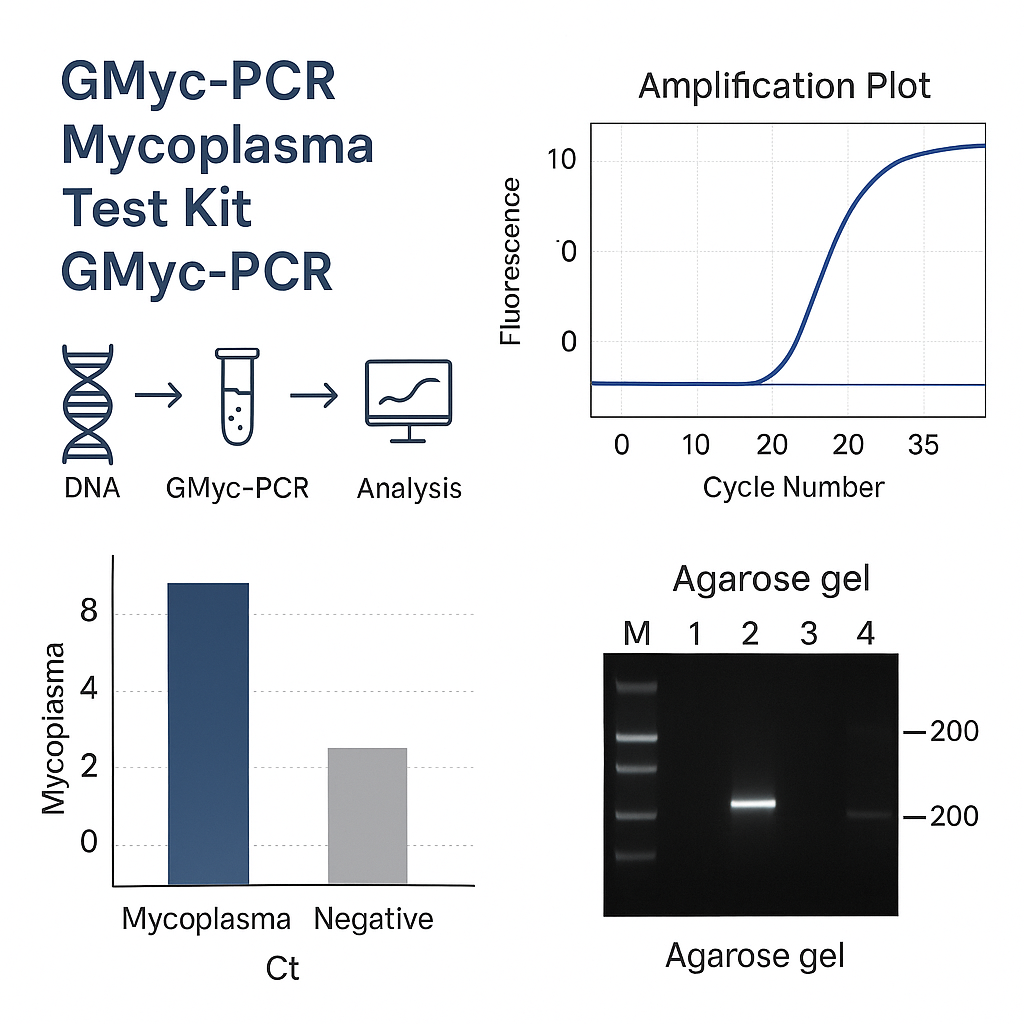
Positive sample: distinct amplification band (≈ 270 bp) or specific fluorescence threshold (Ct < 35).
-
Negative sample: no band visible, flat baseline fluorescence.
-
Invalid result: absent control amplification, suggesting reagent degradation or PCR inhibition.
Documentation of analytical result interpretation standards can be found at the CDC Laboratory Quality Assurance Division.
Storage and Stability
All reagents in the GMyc-PCR kit are stable at −20 °C for at least 12 months. Avoid repeated freeze–thaw cycles to preserve enzyme activity.
For long-term storage conditions, consult the World Health Organization Laboratory Biosafety Manual.
Quality Control and Standards
Each batch is validated under:
-
ISO 13485 manufacturing guidelines
-
NIH reagent consistency protocols
-
FDA Research Use Only (RUO) compliance
-
Internal positive and negative control checks
Quality monitoring ensures traceability and reproducibility, following frameworks outlined by the U.S. Department of Health & Human Services (HHS) and NIST Reference Methods.
Troubleshooting Guide
| Issue | Possible Cause | Suggested Solution |
|---|---|---|
| Weak or no amplification | Inhibitors in sample | Purify DNA; reduce input volume |
| False negatives | Improper thermal cycling | Verify PCR program and annealing temp |
| False positives | Contamination from previous runs | Use aerosol-resistant tips and separate work zones |
| Faint bands | Low template concentration | Increase sample input or cycles (max +3) |
These troubleshooting practices align with laboratory recommendations from the University of California, Berkeley Molecular Biology Division and NIH Technical Resources.
Comparison to Alternative Mycoplasma Detection Methods
| Method | Sensitivity | Time | Equipment |
|---|---|---|---|
| Culture | Moderate | 7–14 days | CO₂ incubator |
| DNA Staining (Hoechst) | Low | 2–4 h | Fluorescence microscope |
| ELISA | Moderate | 3–5 h | Microplate reader |
| PCR (GMyc-PCR) | High (>98%) | 1.5 h | Thermocycler or qPCR system |
Data consistent with findings published in the Journal of Virological Methods.
Biosafety and Handling
Although the GMyc-PCR kit itself is non-hazardous, users should follow biosafety level 2 (BSL-2) precautions when handling cell cultures.
Consult CDC Biosafety Guidelines and NIH Laboratory Safety Resources for standard protective procedures.
Future Trends and Research Directions
Advancements in digital PCR (dPCR) and loop-mediated isothermal amplification (LAMP) are paving the way for ultra-sensitive Mycoplasma detection.
Research initiatives from MIT Department of Biological Engineering and the National Institute of Standards and Technology (NIST) are focused on integrating AI-based signal interpretation and lab automation to streamline microbial quality control.
Conclusion
The GMyc-PCR Mycoplasma Test Kit provides a rapid, accurate, and highly sensitive solution for detecting Mycoplasma contamination in biological materials.
By integrating advanced primer design, robust enzyme systems, and standardized quality controls, this kit ensures reliable detection across multiple Mycoplasma species.
Its compatibility with routine PCR and qPCR instruments makes it indispensable for research institutions, biotech companies, and academic laboratories striving to maintain culture purity and data integrity.
The GMyc-PCR Mycoplasma Test Kit offers rapid, sensitive PCR-based detection of Mycoplasma contamination in cell cultures. Explore its principle, components, and applications — supported by trusted .edu and .gov scientific sources.