
Indexing fundamentals
What an “index” is
An index is a short DNA tag incorporated into each library so reads can be assigned back to the correct sample after sequencing (demultiplexing). If you want a plain-language refresher, NIH’s NHGRI pages are excellent: DNA sequencing basics (genome.gov) and the Next-generation sequencing glossary entry (genome.gov).
i7 vs i5 (Illumina-style dual indexing)
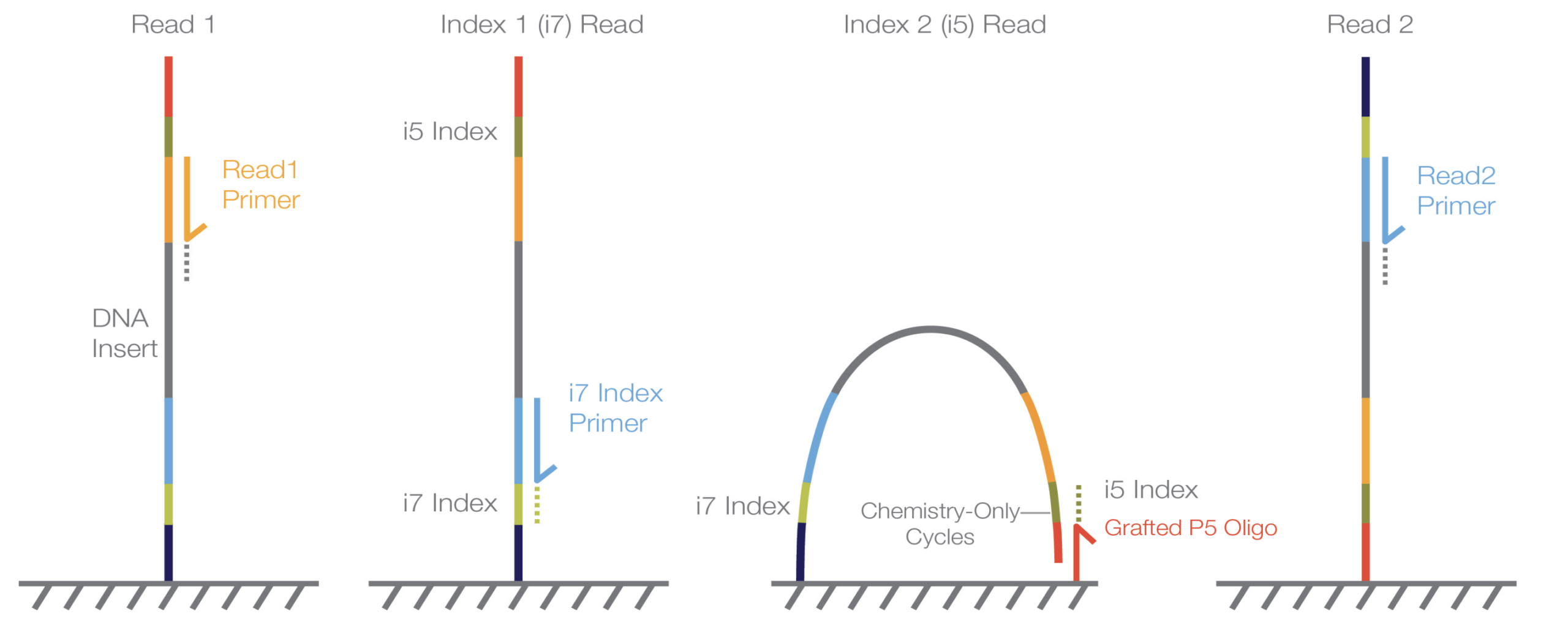
In dual-index Illumina workflows, two barcodes are read in separate “index reads”:
-
i7 (often “Index 1” / I1)
-
i5 (often “Index 2” / I2)
This extra barcode dimension improves sample identification robustness and expands how many unique sample labels you can deploy per run. Practical dual indexing and index misassignment considerations are discussed extensively by Illumina. Illumina+1
Single index vs dual index vs unique dual index
You’ll see three common strategies:
-
Single indexing: only i7 (or only i5) is used.
-
Dual indexing (combinatorial): i7 and i5 are used, but i5/i7 values may be reused across different samples in combinations.
-
Unique dual indexing (UDI): each sample has a unique i5+i7 pair that is not reused within the pool.
Illumina explicitly recommends unique dual indexes when you need stronger mitigation against index hopping, because hopped reads can be filtered when the i5+i7 pair becomes invalid. emea.illumina.com+2knowledge.illumina.com+2

Why dual indexing is central to modern multiplex sequencing
The lab value: higher throughput, simpler projects, fewer runs
Dual indexing supports routine pooling for:
-
amplicon sequencing panels (custom targets, microbial marker genes)
-
small genome projects and pilot screens
-
method optimization (many conditions sequenced together)
-
plate-based workflows where many samples share one run
A concrete example of how index reads and index lists appear in a real protocol is the widely used 16S library prep guide hosted by a university domain: 16S metagenomic sequencing library prep guide (Smith College .edu). (This guide also shows how index sequences are referenced for sample sheets.)
The data value: demultiplexing confidence and “undetermined reads”
After sequencing, demultiplexing assigns reads to samples based on index reads. Reads that fail index matching (or violate expected pairs) become Undetermined (or remain unassigned), depending on the software and settings. Illumina demultiplexing workflows and sample sheet behavior are documented in the bcl2fastq guides and related run-planning materials. support.illumina.com+1
Index misassignment & index hopping: what it is and why UDI matters
The problem
“Index hopping” (also called index misassignment) can occur when reads receive the wrong index during clustering/amplification or due to residual free adapters/primers, leading to incorrect sample assignment—especially in multiplexed pools. Illumina provides a clear overview, including typical ranges and why patterned flow cells can show measurable hopping. emea.illumina.com+1
Academic analyses also model and quantify index hopping and its downstream impact (open access via NIH):
The mitigation hierarchy (from simplest to strongest)
In practice, labs mitigate misassignment by stacking several approaches:
-
Rigorous cleanup to minimize free adapters/primers (library prep QC discipline).
-
Thoughtful pooling (avoid pooling extreme concentration differences when possible).
-
Dual indexing rather than single indexing.
-
Unique dual indexing (UDI) when misassignment risk is especially costly (e.g., low-frequency variant detection, sensitive contamination-prone applications).
Illumina’s UDI guidance is explicit: UDI enables filtering of hopped reads because invalid i5+i7 combinations can be flagged. emea.illumina.com+2knowledge.illumina.com+2
A practical “core facility” explanation (with mitigation discussion) is also available from an academic facility page: Barcode misassignment on patterned flow cells (Michigan State University RTSF .edu). rtsf.natsci.msu.edu
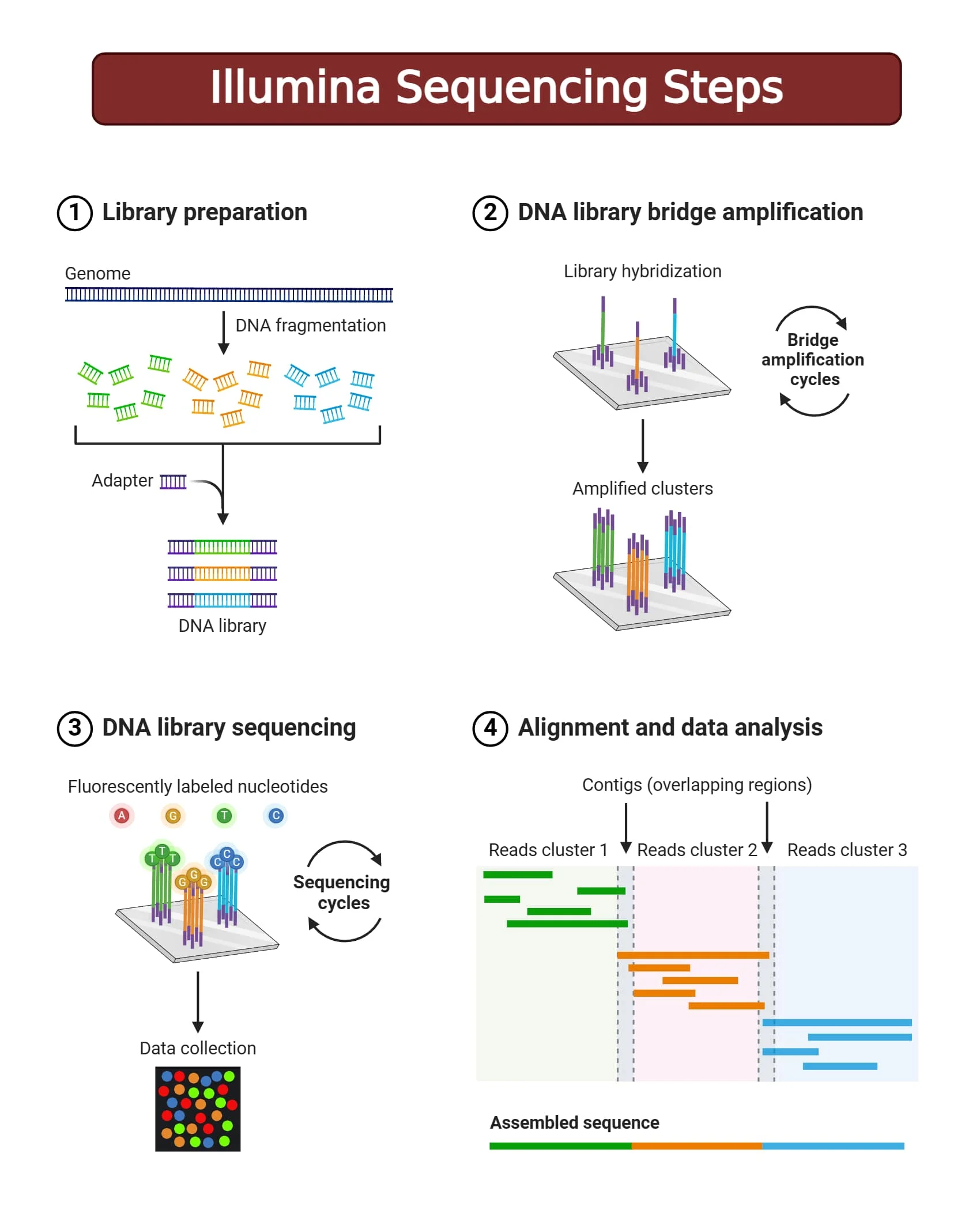
Index diversity & base balance: the hidden determinant of clean runs
Even if your indexes are correct, sequencing performance can suffer when the run lacks nucleotide diversity—especially for low-diversity libraries (amplicons, certain short constructs, or highly similar templates). Illumina has detailed guidance on nucleotide diversity and when PhiX spike-in is recommended. knowledge.illumina.com+3support-docs.illumina.com+3knowledge.illumina.com+3
Why diversity matters (especially on 2-channel chemistry)
Sequencers perform color matrix correction and intensity normalization; low diversity can make early-cycle base calling harder and degrade quality metrics. Illumina’s knowledge-base guidance discusses the relationship between base balance and performance, and typical PhiX recommendations for low-diversity runs (platform dependent). knowledge.illumina.com+2knowledge.illumina.com+2
Practical takeaway for indexing kits
A good indexing plan helps maintain balanced base composition across index cycles in a pool (especially important when you only run a subset of indexes). In plate-based workflows, this often means not picking adjacent indexes “at random,” but choosing combinations known to keep diversity reasonable across cycles.
Demultiplexing workflow: from BCL to FASTQ (and what can go wrong)
FASTQ: what you end up with
FASTQ stores sequence reads plus per-base quality scores (Phred). For authoritative references:
-
Classic FASTQ format paper (open access): Cock et al., FASTQ format (PMC) PMC
-
Quality-score explainer: NCI NGS file formats (cancer.gov) bioinformatics.ccr.cancer.gov
Sample sheets are not optional metadata
In Illumina demultiplexing, the sample sheet drives index-to-sample mapping. The bcl2fastq user guides describe how sample sheets assign indexes and lanes to samples/projects. support.illumina.com+1
Useful university/academic walkthroughs:
-
Demultiplexing procedure and sample sheet example (UGA .edu PDF) GGBC
-
Additional tutorial (UGA PDF): Illumina data demultiplexing tutorial (UGA .edu PDF) GGBC
The i5 orientation trap (Forward vs Reverse Complement)
A frequent cause of “everything went to Undetermined” is entering the i5 index in the wrong orientation for the instrument/software combination. Illumina provides an official index orientation guide, including when i5 must be reverse complemented. knowledge.illumina.com+3help.connected.illumina.com+3help.connected.illumina.com+3
A clear academic example (NovaSeq reverse-complement workflow) is described in:
Also note that newer DRAGEN sample sheet behaviors may automatically handle i5 reverse complementing in some contexts (v2 sample sheets for certain platforms). knowledge.illumina.com+1
A practical troubleshooting map (what to check when results look “off”)
Symptom A: High “% Undetermined”
Common causes:
-
i7/i5 entered incorrectly (typos, swapped columns)
-
wrong i5 orientation (needs RC vs forward)
-
unexpected index read structure (wrong cycle counts)
-
index read quality too low
Actions:
-
verify sample sheet “index / index2” values match the kit documentation exactly bx.psu.edu+1
-
confirm i5 orientation using Illumina’s orientation table help.connected.illumina.com+1
-
review index-read Q-scores (quality) and overall run metrics (Q30, cluster density) using facility SOPs; examples:
Symptom B: Cross-sample contamination signals
Common causes:
-
index hopping (especially on patterned flow cells)
-
low-level lab contamination or carryover
-
index set reuse patterns in combinatorial dual indexing
Actions:
-
prefer UDI where appropriate emea.illumina.com+1
-
follow Illumina’s best-practice mitigation guidance Illumina+1
-
consider facility guidance (example: MSU RTSF page) rtsf.natsci.msu.edu
Symptom C: Low diversity warnings / poor early-cycle quality
Actions:
-
assess nucleotide diversity and consider PhiX spike-in guidance (platform-specific) knowledge.illumina.com+3support-docs.illumina.com+3knowledge.illumina.com+3
Data management: indexing decisions affect public data submission readiness
If your lab submits sequencing data to repositories, indexing and demultiplexing discipline pays off immediately.
-
NCBI SRA expects standard formats and provides guidance for submissions: SRA submission formats (NIH.gov). CNIB+1
-
GEO submission guidance notes expectations around FASTQ for certain studies: Submitting high-throughput sequence data to GEO (NIH.gov). CNIB
A clean, documented sample sheet and consistent sample naming can save hours when preparing metadata for archiving.
Where TruePrep Index Kit V2 for Illumina fits in real workflows
TruePrep Index Kit V2 for Illumina is positioned as an indexing solution designed to pair with TruePrep library preparation workflows. Product documentation describes that it includes 8 N5XX and 12 N7XX index oligos, enabling 96 dual-indexed adapter combinations. AffiGEN+2vazymeglobal.com+2
What “96 dual indexes” means operationally
In practice, this supports:
-
plate-aligned sample organization (common for labs processing batches)
-
routine multiplex pooling with manageable index tracking
-
reproducible demultiplexing, assuming correct i5/i7 entry and orientation
What to emphasize in your product page/blog (SEO + lab realism)
When writing or optimizing your product content, the terms below match how scientists search:
-
“Illumina-compatible dual index adapters”
-
“i5/i7 indexing kit”
-
“multiplex sequencing barcodes”
-
“Index2 sample sheet”
-
“demultiplexing FASTQ”
-
“index hopping mitigation (UDI)”
-
“balanced index diversity / PhiX for low diversity”
And when you describe usage, keep it grounded in the workflow steps readers recognize: index incorporation → QC → pooling → sequencing → demultiplexing.
Mini FAQ (high-value SEO section)
Does dual indexing automatically prevent index hopping?
Dual indexing improves robustness, and unique dual indexing is a known mitigation strategy because invalid i5+i7 pairs can be filtered. emea.illumina.com+2knowledge.illumina.com+2
Why do i5 indexes sometimes need reverse complementing?
Some instrument/software combinations use a reverse-complement indexing workflow; Illumina provides an official orientation table. help.connected.illumina.com+2help.connected.illumina.com+2
What if my run has low diversity?
Illumina recommends PhiX as a positive control and higher spike-in percentages for low-diversity libraries depending on platform and optimization results. knowledge.illumina.com+3knowledge.illumina.com+3knowledge.illumina.com+3
Where can I learn the sample sheet format quickly?
Start with a core-facility tutorial like UGA’s demultiplexing procedure and sample sheet examples. GGBC+1
Product close
If your lab routinely pools samples on Illumina platforms and wants a clear, structured dual-index set for consistent multiplexing and demultiplexing, TruePrep Index Kit V2 for Illumina provides 96 dual-index combinations (8 N5XX × 12 N7XX) designed for TruePrep library prep workflows—supporting practical plate-based organization and scalable sample barcoding. AffiGEN+2vazymeglobal.com+2
Extra .edu / .gov learning links (useful for your readers)
You can naturally sprinkle these throughout your blog (they’re great trust signals):