
Executive overview
MycoX™ Removal Mix is a Research Use Only (RUO) reagent designed to reduce mycoplasma contamination in mammalian cell culture while preserving routine experimental utility. The mix supports short exposure cycles, washout and recovery, and multi-method verification (PCR/qPCR, DNA stain, culture). This page explains mechanism concepts, line-tuning, recurrence prevention, documentation, and quality control—with direct links to .edu/.gov resources for training, reproducibility, and biosafety.
Primary keywords: mycoplasma removal mix, mycoplasma cleanup, cell culture contamination, RUO, qPCR verification, aseptic technique, cell line QA, lab biosafety.
Secondary keywords: monthly screening, quarantine program, antibiotic-free culture, verification assay, culture enrichment, reagent stability, SOP traceability.

Background: why mycoplasma cleanup matters (research context)
Mycoplasma can distort gene expression, alter metabolism, and impact assay readouts, undermining reproducibility. Core, non-clinical training resources:
What MycoX™ Removal Mix is (concept & compatibility)
-
Intent: Rapid mycoplasma cleanup from actively growing mammalian cultures (adherent or suspension) under RUO conditions.
-
Concept: Multi-target action against Mollicutes (e.g., Mycoplasma, Acholeplasma) to lower the chance of single-pathway resistance (educational framing; exact composition is proprietary).
-
Compatibility: Typical DMEM/EMEM/RPMI with common FBS ranges; validate on your line first.
-
Avoid mixing with overlapping, high-dose antibiotics unless the SOP explicitly allows (possible antagonism).
Reference biology & taxonomy (non-clinical):
Mechanism concepts (educational, non-proprietary)
Cleanup regimens typically combine agents with distinct actions that:
-
Compromise replication or translation in mycoplasma,
-
Penetrate cell culture matrices efficiently,
-
Act in short pulses, followed by washout, to preserve mammalian viability.
Helpful primers on antimicrobial action and lab QA (neutral/educational):
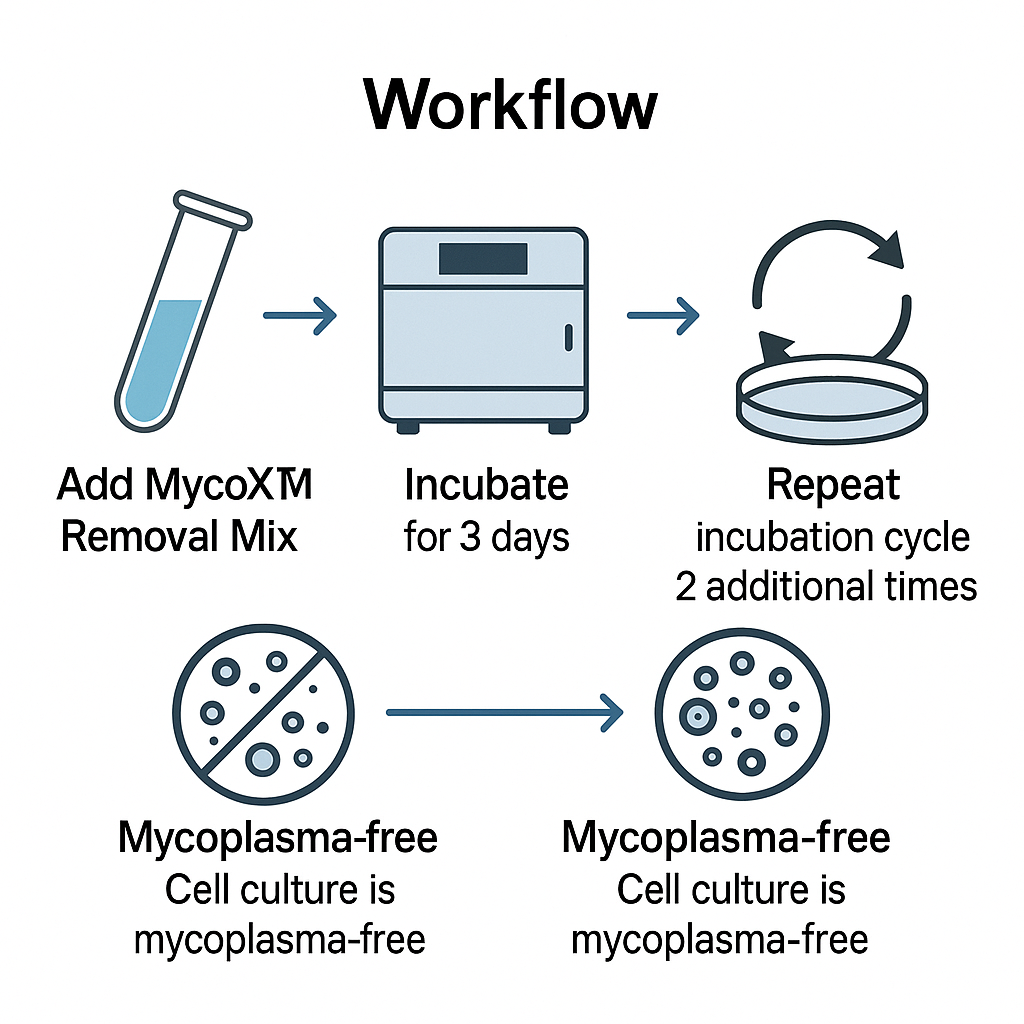
Standard MycoX™ cleanup workflow (step-by-step, RUO)
Follow your product insert for exact dose and exposure time.
Day 0 — Baseline
-
Seed at 30–50% confluence (adherent) or mid-log (suspension).
-
Record viability, morphology, passage, media/sera lots.
-
Save pre-treatment aliquots for verification (PCR/qPCR or DNA stain).
Days 1–3 — Exposure
-
Add MycoX™ Removal Mix at label dose/time.
-
Monitor morphology and viability daily; avoid adding unrelated antibiotics.
Day 3/4 — Washout & recovery
-
Replace with fresh medium.
-
Allow 48–72 h recovery; run interim verification (rapid DNA stain or qPCR).
Days 5–10 — Optional repeat
-
If interim data are equivocal, repeat a second exposure with the same settings.
-
Return to antibiotic-free medium to assess durability.
Days 10–14 — Final verification
-
Run PCR/qPCR (broad multi-species primers) and optionally culture-based enrichment.
-
Archive raw data and a short report for the lot file.
Assay resources:
Verification strategy (use ≥2 orthogonal methods)
Combine two or more from the list below to reduce false calls:
-
PCR/qPCR (broad mycoplasma panels; Ct/Cq tracking).
-
DNA stains (e.g., Hoechst) to visualize extranuclear puncta (screen-level).
-
Culture/enrichment (slower, orthogonal confirmation).
-
External lab certificate for audited projects.
Core, non-diagnostic primers:
Prevention & recurrence control (programmatic approach)
-
Quarantine new lines for ~2 weeks; screen twice before release.
-
Antibiotic-free routine culture to avoid masking contamination.
-
Authenticate lines; keep pedigrees (source, lot, passage, dates).
-
Filter-sterilize additives when compatible.
-
Dedicated pipettes/benches for high-risk tasks.
-
Monthly screening: qPCR + a quick DNA stain snapshot.
Institutional best practices:
Line-specific tuning and cytotoxicity checks
-
Run a mini-panel (3–5 doses × exposure times) on your cell line.
-
Track viability (Trypan Blue/ATP), growth curves, morphology.
-
Choose the lowest effective regimen that meets verification endpoints.
Assay design primers:
Special scenarios (primary cells, 3D, viral work)
-
Primary cells/sensitive lines: shorter exposures, extended recovery.
-
Viral packaging (AAV/retro/lenti): complete cleanup first; mycoplasma can depress titers and confound QC.
-
Co-cultures/3D matrices: verify penetration; consider repeated short cycles.
Neutral references:
Documentation & traceability (QA lot file)
For each cleanup event, maintain a lot history file:
-
Cell line ID, passage, incubator, media/sera lots.
-
MycoX™ lot, dose, exposure schedule, deviations.
-
Verification raw data (Cq values, gels, stain images).
-
Final “Ready for Research” sign-off.
QA references:
Storage, stability, and handling
-
Store at label temperature; protect from light and repeated freeze–thaw.
-
Aliquot on first thaw for single-use.
-
Log open date, min/max temps; dispose per local chemical/biological rules.
General frameworks:

Troubleshooting (quick hits)
| Observation | Likely cause | Corrective action |
|---|---|---|
| qPCR still positive post-cycle | Under-dose or short exposure | Repeat cycle; verify dose/time; confirm with two methods |
| Transient morphology changes | Sensitive cell type | Shorter exposure; higher seeding; extend recovery |
| Recurrence after 2–3 weeks | Cross-contamination | Quarantine all lines; re-screen; refresh shared reagents |
| Poor viability | Overexposure | Reduce dose/time; stagger exposure; add recovery step |
Method references:
FAQ (RUO, non-diagnostic)
Q1. How many cleanup cycles are typical?
Often 1–2 cycles with verification between cycles; sensitive lines may need shorter, repeated pulses.
Q2. Can I keep prophylactic antibiotics during cleanup?
Prefer antibiotic-free routine culture. Avoid overlapping agents unless your SOP specifies.
Q3. Which verification method is “best”?
Use two orthogonal methods (e.g., qPCR + DNA stain). Consider external confirmation for audited studies.
Q4. Will cleanup affect transfection or viral production?
Finish cleanup before production steps; include washout and recovery to minimize interference.
Q5. How do I prevent reinfection?
Quarantine newcomers, authenticate lines, run monthly screens, dedicate pipettes and reagents by room.
On-page SEO checklist (apply before publishing)
-
One H1 (product name) + skimmable H2/H3 blocks.
-
Sprinkle primary keywords top/middle/bottom; keep sentences short.
-
Add ALT text to images: “mycoplasma-cleanup-workflow,” “qPCR-verification-curve,” “aseptic-technique-bench,” “QA-traceability-log.”
-
Internal links to mycoplasma PCR/qPCR kits, DNA stains, cell authentication, sterile filters, pipettes, aseptic-technique blog.
-
Add FAQPage schema to target rich results.