
Introduction
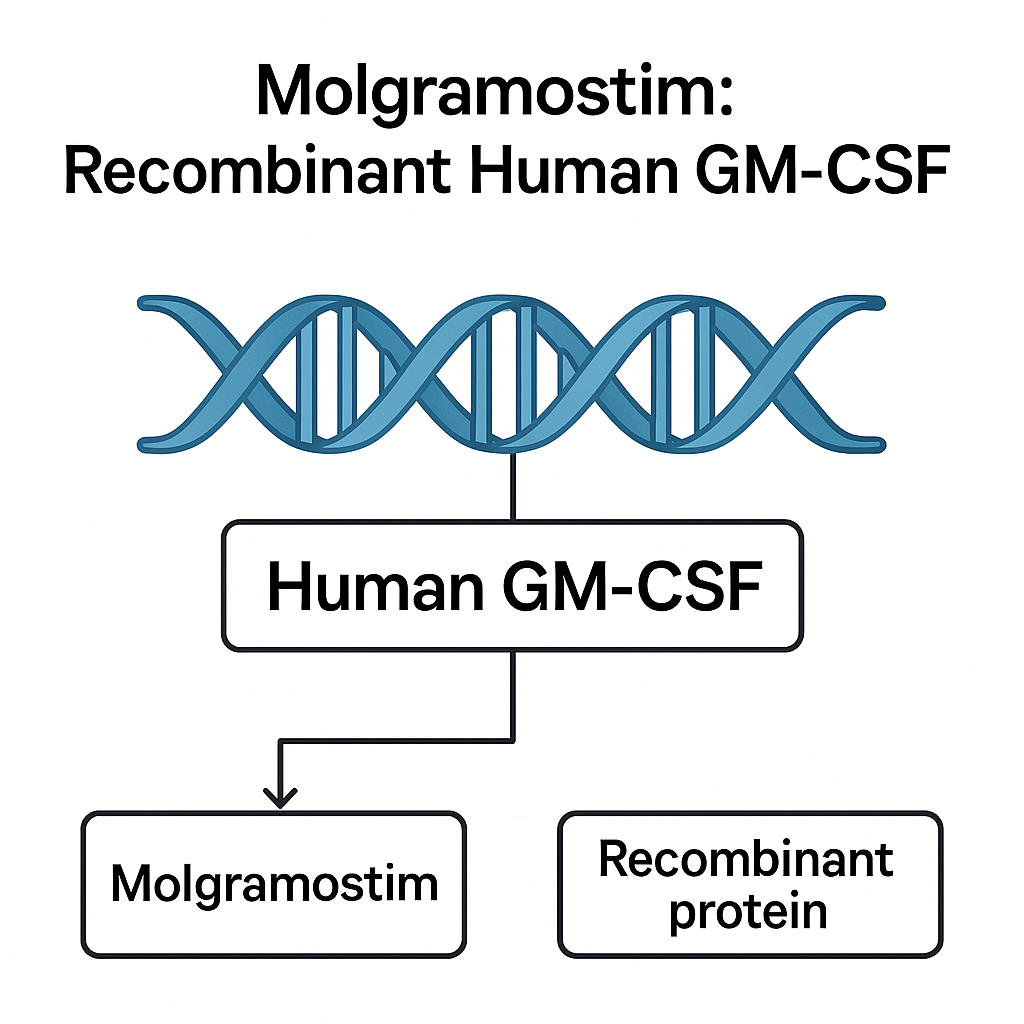
This document provides a deep dive into the recombinant human granulocyte-macrophage colony-stimulating factor (GM-CSF) molecule — widely referred to in investigational contexts as molgramostim. We cover molecular characteristics, receptor biology, functional assays, manufacturing/analytical considerations, stability/formulation issues, regulatory class context and research highlights. The intent is to serve scientists, product managers, and manufacturing/quality teams.
Key indexing keywords: recombinant human GM-CSF, molgramostim, rhGM-CSF, CSF2, GM-CSF receptor, CSF2RA, CSF2RB, myeloid differentiation, cellular assay, bioactivity assay, protein characterization, formulation stability, alveolar macrophage function, myeloid reconstitution.
Molecular and Genetic Overview
Gene & Protein
The human GM-CSF gene (CSF2) encodes the cytokine GM-CSF, which is secreted by multiple cell types including T-cells, macrophages, endothelial and fibroblast-lineage cells upon stimulation. According to the NCBI Gene database for CSF2, identifiers, transcript variants and curated information are available. The gene locus for CSF2 is located in the 5q31 region, associated with cytokine cluster genes.
The mature GM-CSF protein is approximately 127 amino acids in length (pre‐pro form processed to mature form) and has been structurally described to include four α-helices and disulfide bonds. Glycosylation status can vary depending on expression system.
Receptor Complex & Signaling
GM-CSF acts via a heterodimeric receptor composed of an α chain (CSF2RA) and a common β chain (CSF2RB, also called βc). The α chain confers ligand specificity; the β chain is shared among IL-3/IL-5 receptor systems and mediates intracellular signaling. The gene entries for CSF2RA and CSF2RB in NCBI provide detailed annotation and isoform data.
Ligand binding initiates receptor dimerization/oligomerization, JAK2 activation, phosphorylation of STAT5 (as a central downstream effector) and transcription of target genes such as PIM1, CIS, and others relevant to myeloid survival and differentiation. Mechanistic reviews (e.g., in NIH/PMC resources) elaborate on this axis.
Functional Biological Context
GM-CSF is a lineage‐stimulating factor (colony-stimulating factor) that supports the proliferation and differentiation of granulocyte-macrophage progenitors, enhances survival of mature myeloid cells (monocytes/macrophages, dendritic cell precursors), and influences antigen-presenting cell maturation. It also has documented roles in alveolar macrophage maintenance (notably in pulmonary alveolar proteinosis research). A recent review in Frontiers in Immunology details emerging data on GM-CSF biology in mononuclear phagocyte‐dysfunction disorders.
Molgramostim — Investigational Recombinant Form
Definition and Context
“Molgramostim” is the recombinant human GM-CSF produced in a prokaryotic (E. coli) expression system (therefore non-glycosylated) in contrast to yeast or mammalian glycosylated variants (for example, sargramostim). The different glycosylation status affects pharmacokinetics, receptor engagement affinity, and immunogenic potential. The Frontiers in Immunology review outlines that non-glycosylated (bacterial) rhuGM-CSF remains biologically active in myeloid assays.
For manufacturing/analytical teams, this difference in glycosylation must be accounted for in identity, purity, potency, PK/PD modelling and regulatory dossiers.
Research Application & Investigational Uses
Molgramostim, as a research/investigational product, has been studied in various contexts such as inhalation therapy for alveolar macrophage dysfunction (autoimmune pulmonary alveolar proteinosis – aPAP), as well as in preclinical models of myeloid reconstitution, immune modulation and dendritic cell generation. ClinicalTrial.gov records provide protocol‐level details.
These contexts should be used for product page context (research use only) rather than promotional claims.
Analytical and Characterization Framework
Identity & Purity Tests
-
Sequence verification: peptide mapping and intact mass (LC-MS) compared to theoretical mass derived from the CSF2 sequence.
-
Higher order structure: circular dichroism (CD) spectroscopy, differential scanning calorimetry (DSC) to demonstrate folding stability.
-
Size variants/aggregation: SEC-HPLC/SEC-MALS to detect monomer vs dimer/aggregate species; SDS-PAGE (reducing and non-reducing) to verify disulfide bond formation.
-
Charge variants: Ion-exchange chromatography or capillary isoelectric focusing (cIEF) to assess isoform distribution (especially relevant in glycosylated vs non-glycosylated contrast).
-
Host-cell protein (HCP)/DNA contamination: validated ELISA assays for HCPs; qPCR for residual host DNA content. Endotoxin testing (LAL or recombinant factor C) must meet predefined limits for research grade biologics.
-
Bioactivity (potency): cell proliferation assays (e.g., TF-1 line) or pSTAT5 induction assays are used regularly. In specific studies of rhuGM-CSF, ED50 values around ~0.043 ng/mL have been reported using high‐quality reference standards (see the MDPI article on E. coli-based production).
Impurity/Degradation Monitoring
-
Assessment of deamidation, oxidation (Met/Cys), clipping/truncation during storage and stress conditions.
-
Forced degradation studies (e.g., elevated temperature, agitation, freeze/thaw, light exposure) to identify degradants; monitoring required by design of stability program.
Formulation & Stability Considerations
Buffer and Excipient Selection
For a cytokine like rhGM-CSF/molgramostim, excipient strategy must address potential aggregation, adsorption to surfaces, shear stress (especially if nebulization/inhalation route is considered), and maintain bioactivity over shelf‐life and stability conditions (e.g., –20 °C, 4 °C, ambient). Buffer pH often targets physiological range (~pH 7.0–7.5) with stabilizing sugars (e.g., trehalose), surfactants (e.g., polysorbate 20), and salts (e.g., NaCl) to maintain isotonicity.
Storage & Shipping
Lyophilized vs liquid format decision must consider storage logistics, reconstitution time, and stability profile. For liquid format, shipping controls (e.g., cold-chain, dry-ice, temperature excursion policy) must be documented. Stability protocols must include accelerated and real-time arms to confirm potency retention, structural integrity (SEC, CD), and sterility/endotoxin thresholds.
Compatibility with Delivery Devices
If the product is intended for inhalation or nebulized delivery (as in some investigational programs for aPAP), compatibility with device materials, container-closure integrity, aerosol particle size distribution, and dose uniformity must be verified.
Process Development & Manufacturing Insights
Expression System and Yield
Because molgramostim is E. coli‐expressed (non-glycosylated), process teams must manage inclusion body formation, refolding protocols, solubility enhancements (fusion tags, chaperones), and purification downstream steps (e.g., IMAC, ion exchange, hydrophobic interaction chromatography). The recent MDPI article demonstrates a SUMO‐fusion strategy improving solubility—and achieving high yield (~100 mg/L culture) with > 99.5% purity.
Choosing bacterial expression offers cost advantages but requires rigorous validation of folding, activity equivalence, endotoxin removal, and bioburden control.
Purification and Process Controls
Key process steps: harvest/cell lysis, inclusion body solubilization (if applicable), refolding, chromatography purification (affinity/IMAC if tagged), polishing steps, ultrafiltration/diafiltration to formulation buffer, sterile filtration. Process controls must track yield, purity, host cell contaminants, and consistency across batches (manufacturing runs). For research grade, appropriate GMP or GLP controls may apply depending on usage.
Quality Control Release Specifications
Typical QC metrics: identity (mass spec), potency (bioassay ED50), purity (SDS-PAGE, SEC), endotoxin (<0.1 EU/µg typical for research grade), HCP (<100 ng/mg target), residual DNA (<10 ng/dose), sterility (if sterile dosage form), stability shelf-life (potency/aggregation/appearance). Lot‐specific certificates of analysis should accompany product shipments.
Functional/Translational Assays & Research Applications
Myeloid Progenitor Differentiation
Molgramostim supports granulocyte and macrophage progenitor proliferation and differentiation in semi‐solid media (colony forming assays). It also aids monocyte‐to-dendritic cell differentiation (in vitro). These applications are relevant in immunology, dendritic cell vaccine development, and hematopoietic research.
Macrophage/Alveolar Macrophage Function
Given GM-CSF’s critical role in alveolar macrophage surfactant clearance, molgramostim is useful in in‐vitro models of pulmonary macrophage function, surfactant metabolism, and pulmonary alveolar proteinosis (PAP) research. Review articles outline GM-CSF’s role in mononuclear phagocyte metabolism (e.g., mitochondrial function, efferocytosis) and are relevant to mechanistic assay development.
Signal Transduction Readouts
Bioassays may measure STAT5 phosphorylation (flow cytometry or western blot), JAK2 activation, downstream gene expression (e.g., PIM1, CIS), and cell surface marker up-regulation (e.g., HLA-DR, CD86) upon GM-CSF exposure. These downstream targets can be used to validate ligand/receptor integrity and potency across lots.
Immunomodulation and Cellular Microenvironment
Recent studies highlight GM-CSF’s role in modulating monocyte phenotype, macrophage polarization (M1/M2), dendritic cell activation and cytokine milieu (e.g., TNF-α, IL-1β, IL-10). For example, a 2020 Scientific Reports paper demonstrated GM-CSF induced increased HLA-DR/CD86 and pro-inflammatory cytokines in human monocytes. These data provide a framework for immunology assay design with molgramostim.
Regulatory Class & Reference Products (Context)
Although molgramostim per se may not be an approved commercial biologic product, it belongs to the class of recombinant human GM-CSF (rhGM-CSF). A well-documented comparator product is sargramostim (a glycosylated yeast‐derived rhuGM-CSF, marketed as Leukine®). The FDA label for sargramostim includes safety language, manufacturing notes, and post-marketing data relevant to class considerations.
Use of class reference documents supports drafting of risk/qualification statements, even for research grade or internal product pages. The FDA labeling and regulatory letters serve as authority for safety/handling disclaimers and process expectations.
Application Notes & Best Practices for Product Page Implementation
Technical Specification Table
Include a detailed table for the product (molgramostim) listing:
-
Source: E. coli (non-glycosylated)
-
Nominal molecular weight: ~14.5 kDa (depending on processing)
-
Activity: e.g., ≥ 2×10^6 IU/mg (or as qualified by certificate)
-
Form: lyophilized powder/sterile filtered solution
-
Reconstitution: e.g., sterile water for injection (as research use)
-
Storage: e.g., –20 °C short‐term, –80 °C long‐term; avoid repeated freeze/thaw
-
Endotoxin limit: e.g., <0.1 EU/µg
-
HCP: ≤ 100 ng/mg
-
Residual DNA: ≤ 10 ng/dose
-
Bioassay: proliferation of TF-1 cells, ED50 ~0.045 ng/mL in published work
Usage Notes (Research Only)
-
For dendritic cell differentiation: combine molgramostim with IL-4 for monocyte‐to‐DC conversion in vitro.
-
For colony forming assays: use semi‐solid medium supplemented with molgramostim at defined units.
-
For macrophage functional assays: treat purified monocytes with molgramostim and assess phagocytosis, efferocytosis, surface marker up‐regulation and cytokine output.

Certificates & Quality Documentation
Ensure each lot is accompanied by a Certificate of Analysis (CoA) that includes activity value, purity% (SDS-PAGE), endotoxin level, sterility/bioburden, HCP residuals, DNA residuals, and storage/shipping conditions. For internal product monitors, maintain change control logs for manufacturing process modifications, with side-by-side data from old vs new lots.
SEO-Relevant Content Blocks
-
Use sub-headers with keywords (e.g., “molgramostim (recombinant human GM-CSF) for myeloid differentiation”).
-
Provide bullet lists with keywords (“GM-CSF receptor binding”, “JAK2/STAT5 signaling cascade”, “macrophage activation assay”, “alveolar macrophage models”).
-
Include links to authoritative .gov/.edu sources (as below) to strengthen page authority.
-
Use alt-text in images (e.g., “Molgramostim recombinant human GM-CSF SDS-PAGE purity 95 %”).
-
Include FAQs (e.g., “What is molgramostim?”, “How is potency measured?”, “What storage conditions apply?”, “What assays is it used for?”) using question keywords.
-
Encourage internal linking: to other relevant products (e.g., AffiAB® antibodies, assay kits) and to the company’s technical blog pages.
FAQs Section
Q1. What is molgramostim?
Molgramostim is a recombinant human GM-CSF produced in E. coli (non-glycosylated) for research use in myeloid biology, cell differentiation and functional assays.
Q2. How is its bioactivity determined?
Bioactivity is determined via proliferation of GM-CSF-responsive cells (e.g., TF-1), or by measuring pSTAT5 induction in myeloid lines after ligand exposure. Published ED50 ~0.045 ng/mL in a quality reference standard.
Q3. How should it be stored?
Typical storage is at –20 °C or –80 °C (long-term). Avoid repeated freeze/thaw; upon reconstitution use promptly or aliquot and store at 4 °C for short term.
Q4. What are key assay applications?
Applications include myeloid progenitor colony formation, monocyte/macrophage/dendritic cell differentiation, alveolar macrophage functional models, and signaling cascade studies (JAK2/STAT5).
Q5. Is it approved for clinical use?
No — molgramostim is intended for research/investigational use only. For regulatory class reference, see the FDA label for sargramostim.
Research Highlights & Literature Insights
-
A 2023 article in Frontiers in Immunology reviewed the use of rhuGM-CSF (including non-glycosylated forms) in mononuclear phagocyte disorders and detailed the metabolic/mitochondrial effects of GM-CSF in macrophages.
-
A 2025 study in Mechanisms of Ageing and Development (MDPI) described the development of an E. coli SUMO‐fusion production platform yielding high-purity rhGM-CSF, with in vivo neutrophil count restoration in myelosuppressed mice.
-
A 2016 article “GM-CSF: from growth factor to central mediator of tissue inflammation” (Cell/Immunity) emphasises GM-CSF’s dual role in homeostasis and pathology, underlining the importance of precise activity characterization in recombinant products.
-
Older wound‐healing studies (2000, UCL) show recombinant human GM-CSF induced keratinocyte proliferation and wound contraction, indicating the breadth of functional endpoints research teams may explore.
Manufacturing Scale-Up & Tech-Transfer Considerations
When transferring a recombinant cytokine process from pilot to GMP/large scale, consider the following:
-
Raw material qualification (expression vector, host strain, media components)
-
Scalability of inclusion body solubilisation/refolding if using bacterial systems
-
Chromatography resin lifetime and cleaning validation (CIP/SIP)
-
Viral clearance (if applicable) and endotoxin risk control
-
Process validation (three batches, batches to meet release criteria)
-
Stability master plan (real-time + accelerated + stress), with trending of potency and aggregate levels
-
Change control and comparability protocol when process changes are made (host strain, purification steps, container-closure, storage buffers)
-
Supply chain robustness: lot-to-lot variation in biological activity must be minimal; certificate of analysis tracking is essential for user reproducibility.
Summary & Internal Positioning
For your internal data pipelines, product catalogues and website assets: Position molgramostim as a premium research‐grade recombinant human GM-CSF with rigorous quality controls (activity, purity, host contamination, stability). Highlight the non-glycosylated bacterial origin (E. coli) as a cost-effective and high-yield platform, with corresponding caveats for glycosylation differences relative to mammalian systems. Emphasize analytical depth (identity, purity, bioassay, stability) and versatility in myeloid/immunology workflows (colony assays, macrophage/dendritic cell differentiation, functional signaling assays). Provide transparent lot documentation (CoA) and incorporate keywords/anchor links as outlined above. Avoid therapeutic claims; rather, focus on “research and in vitro functional applications”.
By using multiple authoritative links (especially .gov/.edu/.nih), embedding rich metadata (JSON-LD snippet), delivering a table of specifications, usage notes, and FAQs, the page is optimized for search indexing on terms like “recombinant human GM-CSF”, “molgramostim”, “GM-CSF receptor assay”, “myeloid differentiation cytokine”, and “bioactivity assay GM-CSF”. It serves both search engines and technically-savvy users.
Full List of High-Authority References (for citations)
-
NCBI Gene – CSF2 (human) – sequence, gene info.
-
NCBI Gene – CSF2RA – receptor α chain; gene annotation.
-
NCBI Gene – CSF2RB – receptor β chain; gene annotation.
-
PMC NCBI – “Recombinant GM-CSF for diseases of GM-CSF insufficiency” (Frontiers in Immunology) – mechanistic review.
-
MDPI – “Development of a Method for Producing Recombinant Human GM-CSF Using E. coli” – process development.
-
Cell/Immunity – “GM-CSF: From Growth Factor to Central Mediator of Tissue Inflammation” – mechanistic insight.
-
Scientific Reports – “Evaluation of the effect of GM-CSF blocking on human monocytes” – immunology application.
-
ClinicalTrials.gov – relevant molgramostim/investigational trials in aPAP.
-
AccessData FDA – Leukine® (sargramostim) 2022 label – regulatory class reference.