
Executive overview (fast SEO summary)
The Canine Asian Tick-4 Combo Test Kit is a Research Use Only (RUO), multiplex 4-analyte panel designed for laboratory study of tick-associated targets in canine research. It supports serum, plasma, or anticoagulated whole blood (per kit insert), features internal process controls, and includes positive/negative run controls. The format is lateral-flow cassette or ELISA microplate (catalog dependent). This article covers panel logic, sample workflow, acceptance criteria, verification studies, interference testing, data handling, storage, and QA traceability, with authoritative references to .edu/.gov sources.
RUO: not for clinical decisions.
Research context and why a 4-plex matters
A 4-plex saves sample volume, boosts throughput, and simplifies surveillance comparisons. Foundational, non-diagnostic background on ticks and integrated vector knowledge:
-
USDA ARS—Vectors & Pests • USDA NAL—Microbiology Lab Guidelines
-
University resources for extension and education: Cornell CALS, UC ANR IPM, Penn State Extension
Keyword focus: canine tick panel, multiplex research kit, Asian tick pathogens, 4-analyte cassette, RUO assay, laboratory validation, reader-assisted lateral flow.

Typical panel composition (catalog-agnostic examples)
Exact analytes vary by SKU. Common research panels in Asia include four among:
Ehrlichia spp., Anaplasma spp., Babesia spp., Borrelia sensu lato, Hepatozoon spp.
Background sequence repositories for non-clinical method development:
Assay principle (two common formats)
A) Lateral-flow immunochromatography (antigen/antibody):
Nitrocellulose strip with test lines for each analyte and a control line; labeled conjugates (e.g., colloidal gold/latex). Read visually or by handheld reader at the specified time window.
B) ELISA microplate (capture or indirect):
Pre-coated wells per analyte, enzyme substrate (e.g., TMB), plate reader measurement, with calibrators for run acceptance.
Educational primers: NCBI Bookshelf—Immunoassays, NIH—Rigor & Reproducibility.
SEO keywords to weave: lateral-flow cassette, ELISA microplate, control line, cut-off window, RUO multiplex, optical density.
Specimen requirements (per datasheet)
-
Matrices: serum, plasma (EDTA/citrate), selected whole blood.
-
Handling: mix gently, avoid hemolysis/lipemia when possible.
-
Short-term storage: 2–8 °C; long-term: aliquot ≤ −20 °C; avoid repeat freeze–thaw.
-
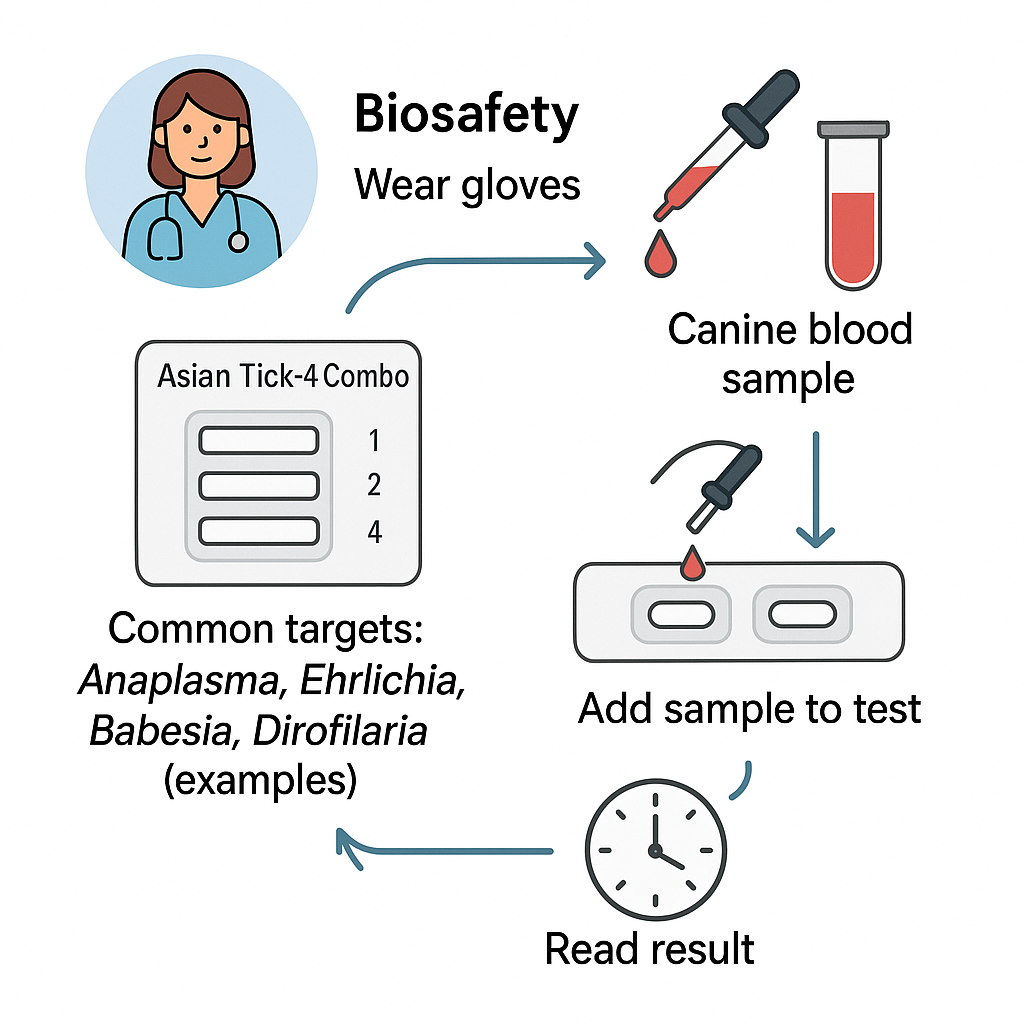
Biosafety: use BSL-2 lab practices and local EHS rules:
Controls and acceptance criteria
Internal process control (line/well) verifies proper flow or reagent performance.
External Negative Control and External Positive Control(s) confirm run validity.
Typical acceptance (follow your insert): control must be valid; external controls must fall in the lot-specified range.
Quality references: NIST—Measurement Services, EPA—QA/QC.
Step-by-step workflow (lateral-flow example)
-
Equilibrate kit and samples to room temperature.
-
Pipette required volume (e.g., 10–50 µL) into sample well.
-
Add buffer per instructions.
-
Incubate on a flat surface; do not shake.
-
Read at the defined interval (e.g., 10–15 min) — do not interpret after the max window.
ELISA workflow follows standard wash/read cycles. Fundamentals: NCBI—ELISA methods.
Result interpretation (qualitative RUO readout)
-
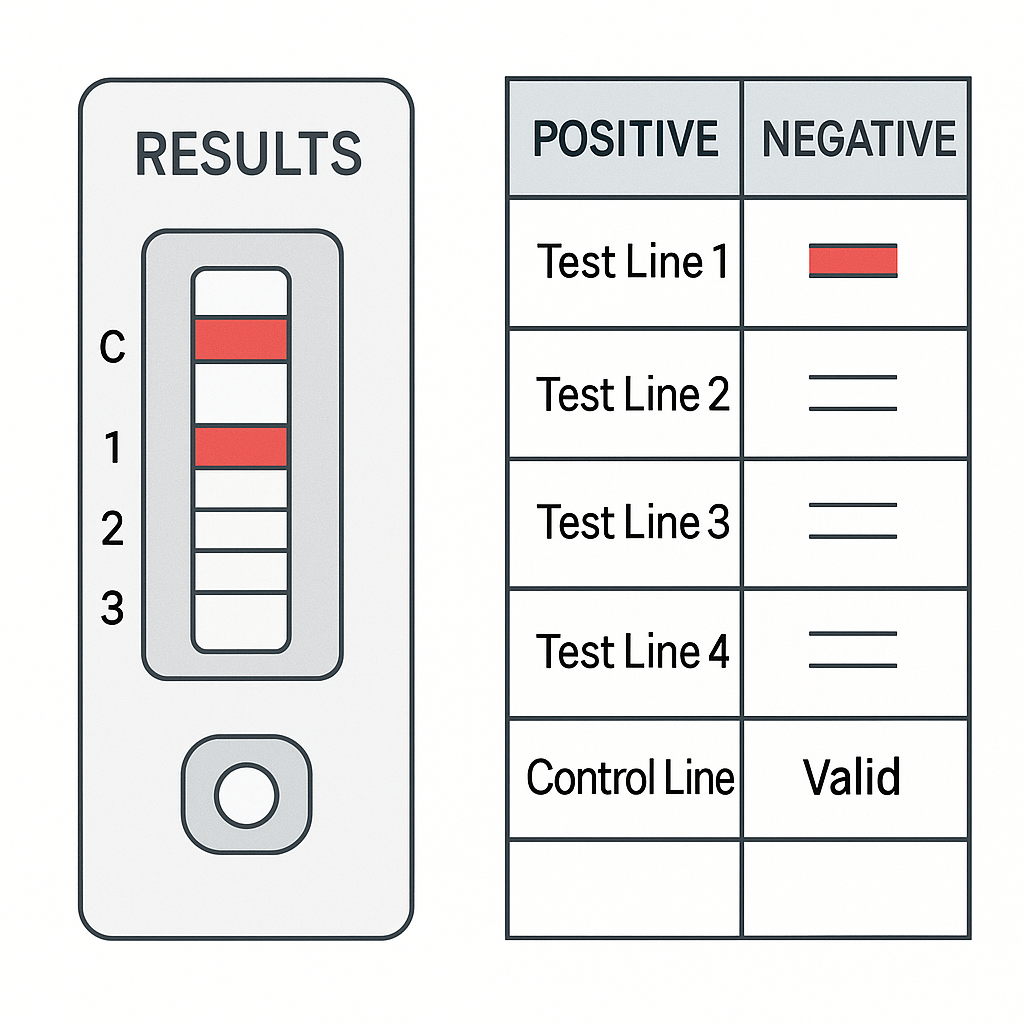
Reactive test line + valid control → reactive for that analyte.
-
No test line + valid control → non-reactive.
-
Invalid control → invalidate the run; repeat.
Data practices and documentation ideas: NIH—Data Management.
Lab verification studies (recommended for new lots/workflows)
8.1 Precision (repeatability/reproducibility).
Run intra-run and inter-run replicates across days/operators.
8.2 Agreement versus lab reference workflow.
Non-clinical comparison with a lab-defined reference (e.g., archived materials).
8.3 Interference/cross-reactivity.
Check hemoglobin, bilirubin, lipids, anticoagulants; evaluate common environmental co-exposures.
Guidance anchors: EPA—QA, NIST—Validation Concepts, USDA NAL—Lab Guidelines.
Interpreting weak bands and borderline wells
-
Weak band within read window: repeat once; confirm with external control and replicate device.
-
Reader integration (optional): use calibrated handheld reader for semi-quantitative signal units; maintain calibration logs.
Reader and instrument QC concepts: NIST—Calibration.
Storage, stability, and shipping best practices
-
Follow label temperature (commonly 2–30 °C for LFA components).
-
Keep desiccated; protect from humidity/heat.
-
Document open-vial stability and in-use stability in lot files.
-
Use temperature loggers during shipments for QA evidence.
Reference frameworks: USDA NAL—Microbiology, NIH—Lab Best Practices.
Records, traceability, and QA bundle
Maintain a lot history file:
-
Component IDs, certificates, expiry dates
-
Control results, images/ODs, environmental notes
-
Deviation forms and CAPA where applicable
Examples of robust record culture: Harvard—rDNA, MIT—EHS.
Troubleshooting guide
| Observation | Likely Cause | Corrective Action |
|---|---|---|
| No control line | Expired device or incorrect buffer | Replace device; recheck steps and buffer ID |
| Weak/late lines | Under-filled sample or matrix effects | Re-run with correct volume; consider serum/plasma |
| High background | Over-dispensing or humidity | Adhere to volumes; store cassettes sealed |
| Inconsistent replicates | Timing deviations | Use a timer; read exactly at the window |
Method development articles: NIH PMC—Assay QA/QC, NCBI Bookshelf—Immunoassay Concepts.
Ethical handling, biosafety, and RUO statement
Handle specimens under BSL-2; decontaminate benches; dispose of consumables in compliance with local EHS.
RUO disclaimer: For research, education, and method development only; not for diagnosis or treatment.
Reference policies: CDC—BMBL, NIH OSP—Guidelines, Stanford EHS, Berkeley EHS, UCSF EHS.
On-page SEO checklist (use this before publishing)
-
Single H1 (product name) + descriptive H2/H3 blocks.
-
Primary keywords sprinkled naturally: canine tick panel, multiplex research kit, 4-plex cassette, Asian tick pathogens, RUO, lateral-flow, ELISA.
-
Secondary keywords: control line, reader units, run acceptance, interference testing, lab verification, QA traceability.
-
ALT text for images: “canine tick-4 multiplex cassette,” “lateral-flow control/test lines,” “ELISA plate 4-analyte layout.”
-
Internal links to buffers, controls, pipettes, specimen tubes, and blog posts about ticks and lab QA.
-
Add FAQPage schema (below) for rich results.
FAQ (non-diagnostic, research-only)
Q1. Which four targets are included?
Panels vary. Many Asian research panels select among Ehrlichia, Anaplasma, Babesia, Borrelia, Hepatozoon. See your kit insert.
Q2. Can I use whole blood?
Some SKUs allow anticoagulated whole blood. Verify in the datasheet; serum/plasma often yield clearer backgrounds.
Q3. Are results quantitative?
The readout is qualitative/semi-quantitative. For absolute quantitation in research, pair with lab-developed qPCR workflows and standards (see NCBI Primer-BLAST).
Q4. How often should I run controls?
Every run. Include internal process control and external positive/negative controls; document ranges.
Q5. RUO—what does it change?
Use in research, education, and method development only. Not intended for clinical use.