
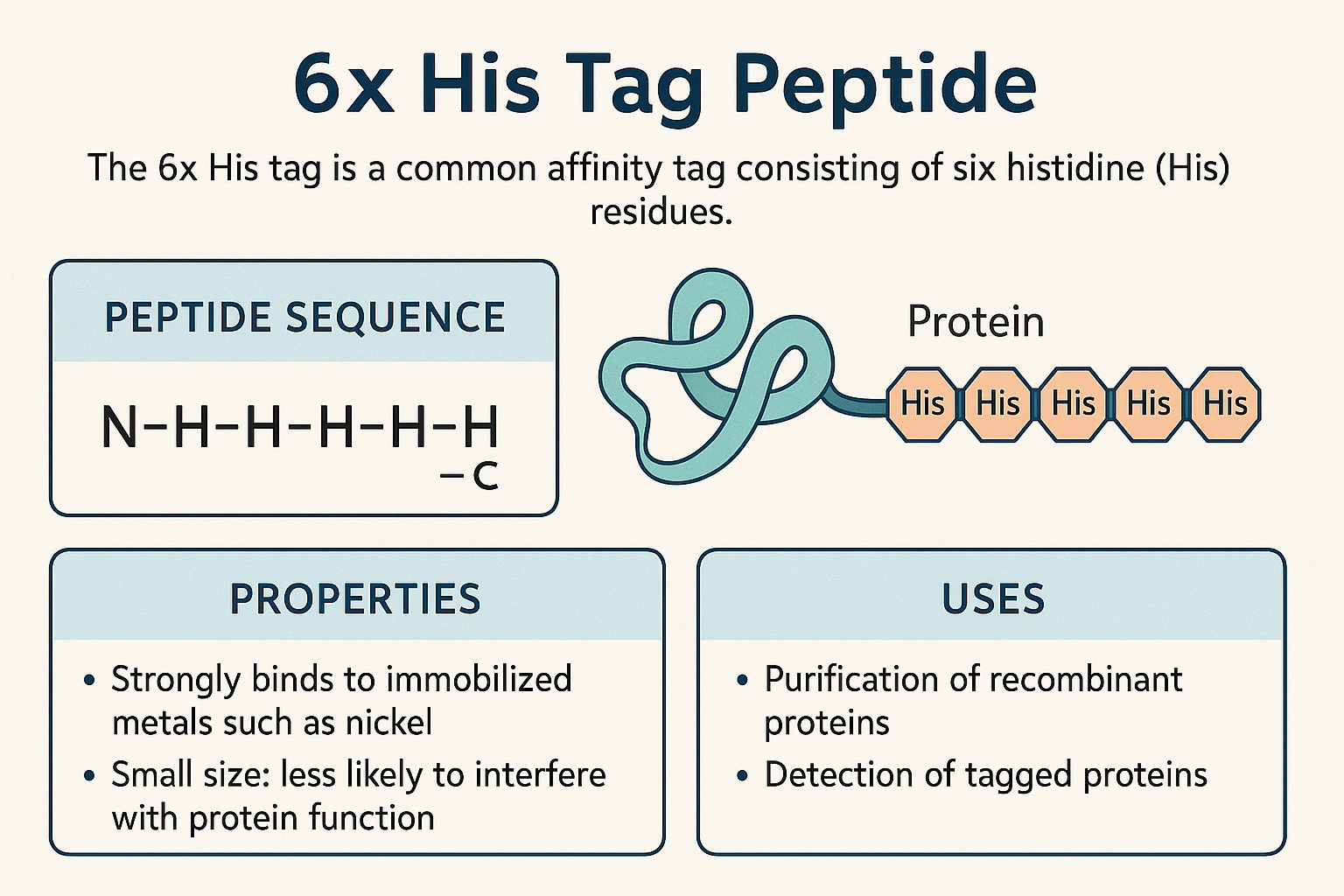
The 6X His Tag Peptide, also known as the Hexa-Histidine Tag, is one of the most widely used fusion tags in recombinant protein technology. Its sequence consists of six consecutive histidine residues (His-His-His-His-His-His), which allow efficient purification, detection, and immobilization of recombinant proteins through metal affinity systems.
Originally popularized by researchers from Stanford University, this short peptide has become an essential component of molecular cloning, protein expression, and biochemical analysis protocols. Its small size and chemical neutrality make it ideal for fusion at either the N- or C-terminus of a target protein without disrupting native folding or function.
Structural and Chemical Characteristics
Each histidine residue in the 6X His tag contains an imidazole side chain capable of coordinating divalent metal ions such as nickel (Ni²⁺), cobalt (Co²⁺), or zinc (Zn²⁺). This coordination forms the basis of Immobilized Metal Affinity Chromatography (IMAC) — a method widely documented by the National Center for Biotechnology Information (NCBI).
The physicochemical properties of the 6X His tag include:
-
Molecular weight: ~0.84 kDa
-
Isoelectric point (pI): 7.3–7.9 depending on sequence context
-
Charge distribution: mildly positive under neutral pH
-
Affinity constant: strong binding to Ni²⁺ chelated by NTA (nitrilotriacetic acid) or IDA (iminodiacetic acid) matrices
These attributes provide predictable interaction strength and high selectivity, as shown in publications by the Journal of Biological Chemistry (JBC).

Mechanism of Metal-Chelate Interaction
The binding mechanism is based on the chelation of metal ions immobilized on solid supports such as agarose or magnetic beads. Nickel-NTA or cobalt-Talon matrices coordinate with the imidazole ring nitrogens of histidine residues.
When the tagged protein flows through the column, it selectively binds to the immobilized metal ions, while other proteins lacking histidine motifs are washed away.
Elution occurs through:
-
Competitive displacement using 100–300 mM imidazole
-
pH reduction to protonate histidine side chains
-
Chelator treatment with EDTA to remove metal ions
Detailed mechanistic studies can be found in research articles from the National Institutes of Health (NIH) and laboratory manuals from MIT Department of Biology.
Design and Genetic Fusion Strategy
The genetic incorporation of the 6X His tag is achieved by oligonucleotide insertion into expression vectors. The tag can be fused to either terminus of the open reading frame, often linked by a protease cleavage site such as TEV (Tobacco Etch Virus) or Thrombin to allow removal after purification.
For optimized cloning and vector design, see resources from the Addgene Plasmid Repository and University of California, Berkeley Molecular Cloning Center.
The tag’s versatility extends across bacterial, yeast, insect, and mammalian expression systems — including vectors such as pET, pGEX, pCMV, and pFastBac.
Purification Using Immobilized Metal Affinity Chromatography (IMAC)
IMAC is the most common method for purifying 6X His-tagged proteins. It relies on a matrix charged with Ni²⁺, Co²⁺, or Zn²⁺ ions, typically chelated via nitrilotriacetic acid (NTA) ligands.
Steps in IMAC purification:
-
Cell lysis using mechanical or enzymatic methods
-
Clarification by centrifugation or filtration
-
Column loading where His-tagged proteins bind metal ions
-
Washing to remove non-specific proteins
-
Elution with imidazole or pH gradient
Detailed technical guidance can be found in the Protein Expression and Purification Protocols by the U.S. National Library of Medicine.
Detection and Quantification
Detection of the 6X His tag can be achieved via:
-
Anti-His monoclonal antibodies in Western blot or ELISA formats
-
Fluorescent or enzyme conjugates (HRP, FITC, Alexa Fluor)
-
Metal-chelating dyes such as Pro-Q Diamond or Lumio reagents
These assays are described in detail by the FDA Center for Biologics Evaluation and Research (CBER) and the National Institute of Standards and Technology (NIST).
Buffer Systems and Experimental Conditions
Typical IMAC buffers for 6X His-tagged proteins contain:
-
20–50 mM Tris-HCl or phosphate buffer (pH 7.5–8.0)
-
300 mM NaCl
-
10–30 mM imidazole (wash buffer)
-
250 mM imidazole (elution buffer)
Maintaining moderate ionic strength prevents nonspecific binding. Researchers from the University of Cambridge Department of Biochemistry recommend adding 0.1% nonionic detergents to reduce background interactions.
Applications in Protein Research
The 6X His tag has applications in:
-
Affinity purification of recombinant proteins
-
Protein-protein interaction studies
-
Pull-down assays and co-immunoprecipitation
-
Surface plasmon resonance (SPR) immobilization
-
X-ray crystallography and NMR structure determination
The tag also facilitates site-specific immobilization on Ni-NTA biosensors for biolayer interferometry (BLI) or ELISA plates for antibody binding studies, as demonstrated in NIH Research Portals.
Advantages of the 6X His Tag
According to studies published in the Journal of Molecular Biology, advantages include:
-
Small size minimizes structural interference
-
Strong metal binding ensures high selectivity
-
Compatibility with denaturing or native conditions
-
Universal detection reagents are widely available
Moreover, its low antigenicity allows safe use in mammalian expression systems.
Limitations and Troubleshooting
Potential challenges involve:
-
Co-purification of host proteins with metal-binding motifs
-
Elution inefficiency if buffer composition is suboptimal
-
Tag interference with enzymatic or structural activity
To mitigate these, laboratories follow tag removal strategies using site-specific proteases such as TEV or Factor Xa. The European Molecular Biology Laboratory (EMBL) provides standardized troubleshooting guides.

Structural Studies and His Tag Influence
Advanced structural analyses by the Protein Data Bank (PDB) confirm that most 6X His tags are flexible and disordered, minimizing structural perturbation.
For high-resolution X-ray crystallography, tag removal is sometimes recommended to reduce electron density artifacts.
Role in Biophysical and Binding Assays
His-tagged proteins are frequently immobilized on Ni²⁺-coated biosensor chips for techniques such as:
-
Surface Plasmon Resonance (SPR)
-
Biolayer Interferometry (BLI)
-
Quartz Crystal Microbalance (QCM)
Protocols from the National Institute of Standards and Technology (NIST) ensure calibration accuracy in quantitative interaction studies.
Modern Developments and Alternatives
Recent innovations have introduced:
-
Twin-Strep tags for higher specificity
-
FLAG® and HA tags for antibody-based purification
-
His10 and His12 tags for enhanced affinity
These systems complement the traditional 6X His tag and are reviewed by NIH Structural Biology Reports.
Storage and Stability of Peptides
Lyophilized 6X His Tag Peptide standards should be stored at −20 °C, protected from light and moisture. Reconstituted solutions remain stable for several weeks at 4 °C with added preservatives such as sodium azide. Handling protocols are outlined in the CDC Laboratory Biosafety Guidelines.
Future Outlook
Research institutions including MIT, Harvard University, and NIST are developing synthetic affinity peptides with tunable metal-binding properties.
The goal is to enhance selectivity, reusability, and automation compatibility for large-scale protein purification in biotechnology and structural proteomics.
Conclusion
The 6X His Tag Peptide remains a cornerstone of recombinant protein research — combining simplicity, robustness, and compatibility with multiple analytical methods. Its ability to enable high-throughput purification and precise detection has transformed molecular biology workflows and continues to evolve alongside modern biotechnology platforms.
As automation, synthetic biology, and bioinformatics converge, the 6X His tag will remain integral to protein engineering and analytical biochemistry for decades to come.
Explore the structure, chemistry, and biotechnological applications of the 6X His Tag Peptide — the gold standard in recombinant protein purification and detection. Learn about IMAC, metal affinity, and design principles from leading .edu and .gov resources.