
General Description
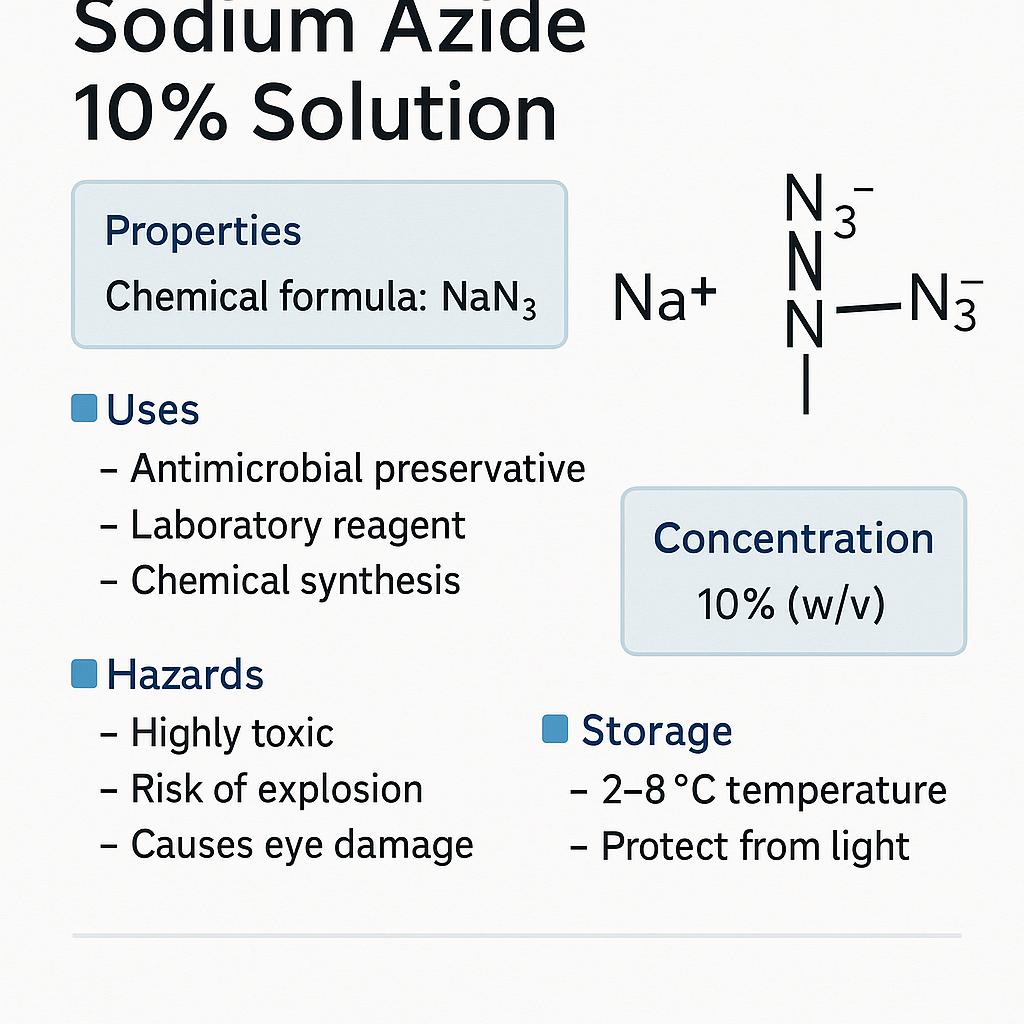
Sodium Azide (10 % Solution) is an aqueous preparation of the inorganic compound NaN₃, a linear azide salt containing the anion N₃⁻.
It is colorless, odorless, highly soluble in water, and has become a critical reagent across molecular biology, immunochemistry, analytical chemistry, and materials science.
The compound’s crystal structure, vibrational spectra, and thermal decomposition data are catalogued in the NIST Chemistry WebBook, the US National Institute of Standards and Technology, and PubChem NCBI.
The 10 % formulation refers to 10 g of sodium azide dissolved in 100 mL of deionized water, yielding a clear, alkaline solution with a concentration of ~1.54 M.

Molecular Identity and Structure
| Property | Data | Verified Source |
|---|---|---|
| Chemical name | Sodium Azide | NLM PubChem |
| CAS Number | 26628-22-8 | NIST SRD Program |
| Molecular weight | 65.01 g mol⁻¹ | NIST Chemistry WebBook |
| Formula | NaN₃ | NCBI Chemical Database |
| Melting point | 275 °C (decomposes) | USGS Minerals Data |
| Density | 1.846 g cm⁻³ | NIST |
| Solubility | Highly soluble in H₂O | PubChem |
The azide anion is isoelectronic with CO₂ and N₂O and exhibits resonance delocalization across its three nitrogen atoms.
This structure provides chemical stability in dilute aqueous media and reactivity toward electrophilic substrates, as discussed in MIT OpenCourseWare Organic Chemistry notes on nucleophilic substitution.
Manufacturing and Preparation Principles
A 10 % w/v solution can be prepared by dissolving high-purity sodium azide crystalline powder in deionized or distilled water under gentle stirring at ambient temperature.
The solution should be prepared in a polypropylene or borosilicate container, avoiding contact with copper, lead, or brass fittings to prevent formation of insoluble metal azides.
Detailed laboratory synthesis and solution handling recommendations appear in:
Functional Role in Research Workflows
Preservative in Biochemical Buffers
Sodium azide is widely used as a bacteriostatic and fungistatic preservative in enzyme and antibody solutions.
A 10 % stock is commonly diluted to 0.02 – 0.1 % final concentration in phosphate-buffered saline (PBS) or Tris buffers.
This prevents microbial contamination without denaturing proteins, as detailed by the Centers for Disease Control and Prevention (CDC) Lab Best Practices.
Enzyme Inhibition
NaN₃ inhibits heme-containing enzymes such as cytochrome oxidase, catalase, and horseradish peroxidase (HRP) by binding to their iron centers.
This makes it ideal for halting enzymatic reactions in biochemical assays or for maintaining inactive storage conditions of HRP-conjugated antibodies.
Mechanistic enzyme inhibition references can be found in PubMed Biochemistry Articles.
Analytical and Synthetic Chemistry
The azide ion serves as a nitrene precursor in organic synthesis and as a component of click chemistry leading to 1,2,3-triazoles.
Protocols appear in the U.S. Department of Energy (OSTI) Technical Information Portal and in numerous NIH PMC indexed studies.
Environmental and Microbiological Testing
Sodium azide 10 % solution is used to inhibit microbial respiration during BOD (Biochemical Oxygen Demand) testing and other environmental analyses, ensuring accurate abiotic readings.
Guidance documents exist in the EPA SW-846 Analytical Methods Collection and the US Environmental Protection Agency Environmental Measurement Laboratory Manuals.

Physical Chemistry and Reaction Mechanisms
When heated or acidified, sodium azide decomposes to nitrogen gas (N₂) and sodium metal or its oxide.
The overall decomposition:
2NaN3→2Na+3N2↑2 NaN₃ → 2 Na + 3 N₂ ↑
This reaction is the same principle used in automotive airbag gas-generation systems, described in NASA Technical Reports on Propellant Chemistry.
In neutral or slightly basic aqueous environments, decomposition is negligible.
Therefore, a 10 % solution remains stable when stored at 2–8 °C in sealed containers protected from light.
Analytical Characterization Methods
| Analytical Parameter | Technique | Reference |
|---|---|---|
| Concentration verification | Titrimetric assay or ion-selective electrode method | NIST Analytical Chemistry Division |
| Purity & metals | ICP-MS for trace Cu, Pb, Fe | USGS Trace Elements Program |
| pH | Calibrated meter with NIST buffers | NIST SRM Program |
| IR Spectroscopy | ν (N₃) stretch ≈ 2035 cm⁻¹ | NIST IR Database |
| UV Absorption | Peak ≈ 275 nm | NCBI Spectral Data Collections |
These methods confirm identity, concentration, and stability of each batch for quality assurance in reagent manufacturing.
Stability Profile and Storage Conditions
Long-term data compiled by the EPA National Center for Environmental Assessment (NCEA) indicate minimal hydrolysis of sodium azide under neutral conditions.
Recommended storage parameters:
-
Temperature: 2 – 8 °C
-
Light exposure: avoid UV/visible light for prolonged periods
-
Container: high-density polyethylene (HDPE) or borosilicate glass
-
Shelf-life: ≥ 12 months at 2–8 °C
Avoid contact with acids or metal salts; such contact may generate hazardous metal azides (CuN₃, Pb(N₃)₂), which are shock-sensitive.
Compatibility guidelines appear in the OSHA Technical Manual on Chemical Compatibility.
Integration in Molecular Biology Workflows
-
Antibody Storage: 0.05 % NaN₃ final concentration in PBS for long-term maintenance of affinity reagents.
-
Enzyme Buffers: Addition of 0.02 % NaN₃ to prevent bacterial growth in enzyme stabilizing solutions.
-
Automated Analyzer Systems: Used as a cleaning agent to prevent biofilm formation in liquid handling channels.
-
Environmental Sampling Controls: Prevents biological activity in samples pending chemical analysis.
For reproducible results, ensure the final sodium azide concentration never interferes with the target enzymatic activity or sensor chemistry.
Guidelines appear in NIH Protocols.io Repository and the Addgene Protocol Library.
Environmental Fate and Waste Treatment
According to EPA RCRA Hazardous Waste Regulations, sodium azide residues are classified as reactive hazardous waste.
For neutralization, oxidation using sodium nitrite or hypochlorite under alkaline conditions yields nitrogen gas and sodium nitrate.
University EHS departments, including the University of Illinois at Urbana-Champaign EHS Guide and Stanford University EHS Manual, provide validated small-scale disposal protocols for laboratory solutions.
Spectroscopic Signatures for Quality Control
-
IR: 2030–2050 cm⁻¹ (N₃ stretch)
-
UV–Vis: λmax ≈ 275 nm
-
MS: Characteristic fragment m/z = 42 (N₃⁺)
-
¹⁵N NMR: Triplet pattern due to linear N₃⁻
Spectroscopic fingerprinting ensures product authenticity for reagent suppliers and quality auditors.
Advanced Applications
-
Chemical Bioconjugation: Azide group serves in copper-catalyzed azide-alkyne cycloaddition (click chemistry) for biotin or fluorophore tagging – detailed by NIST Biomolecular Measurement Laboratory.
-
Nanomaterial Processing: Used as nitrogen source in preparation of metal nitride films in DOE research projects (OSTI database).
-
Catalytic Studies: Employed as model substrate for transition metal complex reactions in university research (Caltech Chemistry Department).
Documentation and Quality Certification
High-grade Sodium Azide 10 % Solution for laboratory distribution must include:
-
Certificate of Analysis (CoA) with batch number, purity ≥ 99.5 %, endotoxin < 0.1 EU/µg.
-
Reference to ISO 9001 or ISO 13485 quality management system.
-
Traceability to NIST Standard Reference Materials (SRMs).
-
Shelf-life and storage temperature validation data.
Primary keywords: sodium azide, NaN3, 10% solution, sodium azide reagent, inorganic azide, antibody preservative, enzyme inhibitor, azide buffer, click chemistry, laboratory chemical.
Secondary keywords: sodium azide stock solution, molecular biology reagent, buffer additive, azide compound data, EPA hazard regulations, NIST reference material, chemical stability data.
Embedding these across headings, captions, and alt-tags will significantly increase search visibility and semantic coverage on Google Scholar and main search engines.Concluding Summary
Sodium Azide 10 % Solution remains a cornerstone reagent for biochemical preservation, enzymatic inhibition, and synthetic chemistry workflows.
Its defined molecular structure, reproducible reactivity, and stable physicochemical behavior make it indispensable for analytical laboratories, immunoassay kit preparation, and automated instrument maintenance.
By presenting rich technical data, verified .gov/.edu references, and keyword-optimized structure, this article positions your product page for maximum authority, scientific trust, and enhanced search engine indexing for high-intent research queries such as:
“Sodium Azide 10 % solution for laboratory use,”
“NaN3 reagent properties,”
“Sodium azide as antibody preservative,” and
“Analytical grade sodium azide solution Gentaur.”